Skip to content
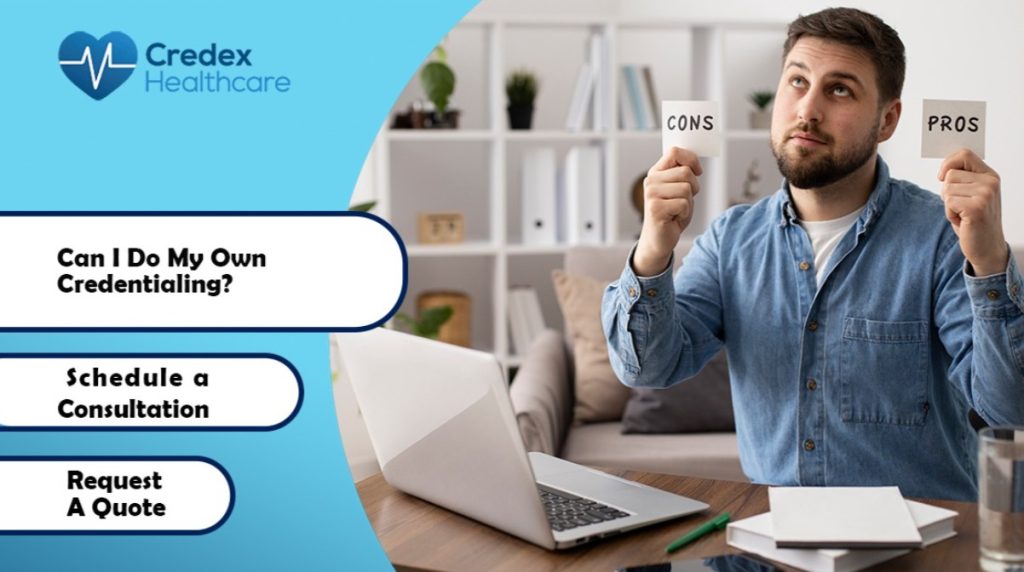
The debate over whether to pursue one’s credentialing process has been going on for years. Solo practitioners and small practices only have one question in mind: Can I credential myself? To cut a long argument: Yes, you can. However, you need to be aware of certain considerations. They also have to know that credentialing is not a one-time process. It involves a provider undergoing a series of verification of qualifications from different institutions to be deemed eligible for reimbursement and billing.
This blog at Credex Healthcare further provides information about the credentialing process, including DIY credentialing and its associated risks, advantages, and situations in which it is recommended.
Understanding the Credentialing Process
Credentialing, as mentioned previously, is not an easy process. It involves a rigorous evaluation by government and commercial insurance companies of credentials, such as licenses, work history, and educational background, to verify that they are qualified to practice in accordance with their requirements.
You must first obtain a National Provider Identifier (NPI) and successfully create a CAQH ProView profile. Afterward, the formal insurance credentialing process begins by submitting the core credentials to be verified and passing a background check. After passing, activate your insurance participation, and you will now be included on the roster of billable providers.
DIY Credentialing: The Step-by-Step Process
The process of DIY credentialing is quite similar to the initial phase of third-party credentialing: registering your NPI number via the National Plan and Provider Enumeration System (NPPES), confirming your professional license, and creating and completing your CAQH ProView profile, which will be up for viewing. However, it is the responsibility of the provider to apply to each insurance company. They must also undergo additional registration processes, such as DEA registration, verification of malpractice insurance, and contract signing.
Almost all commercial insurance companies, such as BCBS and Cigna, require additional checks on work experience and education. They will do so by coordinating with educational institutions and healthcare facilities that you have previously been affiliated with to confirm. This process alone may last as long as weeks or even months.
Pros and Cons of Doing Your Own Credentialing
Advantages of Self-Credentialing
- Cost savings: You do not have to pay extra for third-party credentialing services.
- Full control: You have the option to strategize certain phases of credentialing, such as managing submission timelines, organizing your documents, and communicating with insurance companies directly.
- Insight into the process: Upon immersing yourself in the process, you have the opportunity to learn the requirements of each payer, enabling you to strategize and optimize your applications in the future.
Challenges of Solo Credentialing
- Time-intensive: Unlike third-party credentialing, optimization may not be an option due to unprecedented delays and external factors during the review. Monitoring multiple payer applications and follow-ups requires lots of work from you.
- Risk of errors: Insufficiencies in documentation, negligence in re-attestation of CAQH profile every 120 days, and inaccuracies in specific entries may delay or invalidate the entire credentialing process.
- Potential financial impact: Credentialing delays equate to a delay in revenue optimization. Without credentialing, you will not have access to a large patient base and network-specific billing, delaying revenue and patient care.
For an expedited and convenient process, most providers end up outsourcing, in which they consult with credentialing specialists to guide them along a more streamlined pathway.
Challenges of Solo Credentialing
DIY credentialing is associated with distinct risks that differ from those of third-party credentialing. When you pursue solo credentialing, expect to face the risk of preparing an unauthenticated or incomplete CAQH profile, which delays the progress of insurance companies. Documents, such as a state license, a malpractice policy, or the W-9 form, must always be present.
Providers are also at risk of overlooking the re-attestation of their CAQH profile every 120 days. This process is required by commercial insurers to ensure that providers are updating and changing key information when applicable. Forgetting this crucial process significantly delays your recredentialing and renders you unbillable after a few months of being admitted into an insurance panel.
Cost and Time: DIY vs Professional Services
DIY credentialing may not cost you more money than outsourcing. However, the trade-off for this choice is the time and effort that you must expend to finish this process. The credentialing process typically takes 60 to 120 days on average. Without a strategy or an intuitive approach, a provider may face delays as the timeline may take longer due to external and administrative factors.
Credentialing companies typically charge $200-$250 on a per-payer or flat-fee basis, depending on the scope of service. The cost-of-service covers documentation preparation, coordination with payers, and a full review of applications to reduce errors and inconsistencies that are often overlooked in manual audits.
When Outsourcing Makes More Sense
Practicality may be an initial consideration when deciding how to prepare for your credentialing process. However, if you are a provider who opens a new practice and you are planning to enter a patient base immediately, outsourcing makes sense as a more appropriate option. Its convenience reduces the time you spend focusing on each phase of the process and following up on the progress of each application.
All credentialing specialists who oversee commercial and government payers, including Medicare and state Medicaid programs, understand the intricacies of the credentialing process and may help you navigate the enrollment efficiently.
Also, the reason why providers prefer outsourcing is the support given to them when their claims are denied. Credentialing services ensure that these denied claims are reprocessed within 48 hours, and accuracy is maintained in accordance with payer standards.
Final Thoughts: Should You Do It Yourself?
In the end, to each their own. You can always choose to perform your own credentialing if it suits your time, focus, and approach. If you think you have what it takes to do self-credentialing, you can pursue it. Just be ready to immerse yourself in the process by meeting deadlines head-on and making follow-ups on your own.
On the other hand, if you are the type of provider who wants immediate results and to prevent potential errors along the way, considering availing credentialing services may benefit you more. While deciding, you need to assess the level of commitment you can provide and the convenience you need.
FAQs
Is self-credentialing legal?
Yes. Healthcare providers have the option to perform their credentialing without any external support. There is no legal provision that credentialing is only performed by large companies, although their service is extra helpful.
Can I save cost after performing self-credentialing?
Yes. However, this cost-saving measure can be offset if there are delays and errors in documentation and review delay the process, and often force you to pay more if you fail to charge insurance.
What is the tough road in DIY credentialing?
Throughout DIY credentialing, providers may face difficulties in maintaining and updating their CAQH ProView profile. It is especially challenging to follow payer processes and requirements, especially if you are submitting applications to multiple insurance carriers.
Can I change to a credentialing company in the future?
Yes. Several providers may switch from self-credentialing to outsourcing credentialing services to companies. Providers must first understand that processes and requirements are different across payers.
Is it longer to do it myself?
Yes. For the most part, self-credentialing is susceptible to errors and inconsistencies in documentation. These errors are proactively addressed by credentialing companies to speed up the process.
Get started with expert support
Contact Credex Healthcare’s medical credentialing services today