 Skip to content
Physicians relocate. Practice opportunities shift. Telehealth platforms expand into new markets. Whatever the reason, the need to hold an active medical license in a state apart from where you originally trained or practiced is one of the most common administrative challenges working physicians face in the United States.
Medical license transfer between states is not a single standardized process. Each state runs its own medical board, sets its application requirements, and controls its own review timeline. That said, the process is navigable, and recent developments, particularly the expansion of the Interstate Medical Licensure Compact, have made multi-state licensure faster and more accessible than it was even five years ago.
This guide covers everything you need to know about what the transfer process involves, how the IMLC works, and who qualifies, the step-by-step pathway, what it costs, how long it takes, and how to avoid the delays that slow most applications down.
What Is Medical License Transfer?
Medical license transfer between states is the process of getting a valid medical license in another state. The word “transfer” is often used, but it’s important to know right away that the U.S. does not have a universal medical license. The real process is for the doctor to apply for a new license in the target state. They use their current qualifications, exam history, and professional standing to back up their application.
Doctors do this for a number of reasons. The simplest thing to do is to move to a new state for good. People who work in hospitals that serve patients in more than one state, group practices that grow into neighboring states, online practices that treat patients in more than one state, and locum tenens work all need to have current licenses in each state where they see patients. In 2026, multi-state licensing is no longer a rare paperwork issue for most doctors. It is now a standard part of their work.
Can You Transfer a Medical License Between States?
Yes, though the terminology requires some precision. You can’t shift a license from one state to another as you can with a professional certification. You may get a new license in the state you wish to relocate to based on your present work experience and qualifications. This procedure is often considerably quicker than the first license application since your credentials are already known and can be checked.
Each state in the US has its own medical board with its own requirements for gaining a license, including the documents you need to fill out, evidence of necessity, and how long it takes to complete your application. Certain states work together with other states to make certain portions of the application process simpler. But these deals are only good in that one state, not all of them.
The Interstate Medical Licensure Compact immediately solves this problem for eligible physicians by letting them apply for licenses in several member states with only one application.
Interstate Medical Licensure Compact (IMLC)
The Interstate Medical Licensure Compact is a voluntary agreement between US states and territories that want to make it easier for doctors to get licenses in more than one state. As of 2026, the Compact comprises most US states, which means it covers a large part of the country’s doctors and patients.
To follow the IMLC path, a doctor must designate one partner state as their “State of Principal License,” have a complete license in that state or be able to earn one, and satisfy the other conditions of the Compact. To apply, you must have an unrestricted license in the state of principal license, graduate from a medical school that is approved, complete a residency that is ACGME or AOA-accredited, have a valid DEA registration, and not have any charges, convictions, or license restrictions that would make the application invalid.
Standard state board applications take two to six months to process, but IMLC applications in partner states usually only take two to four weeks. The Compact route is the safest way for physicians who need licenses in more than one state within a certain amount of time to get them faster.
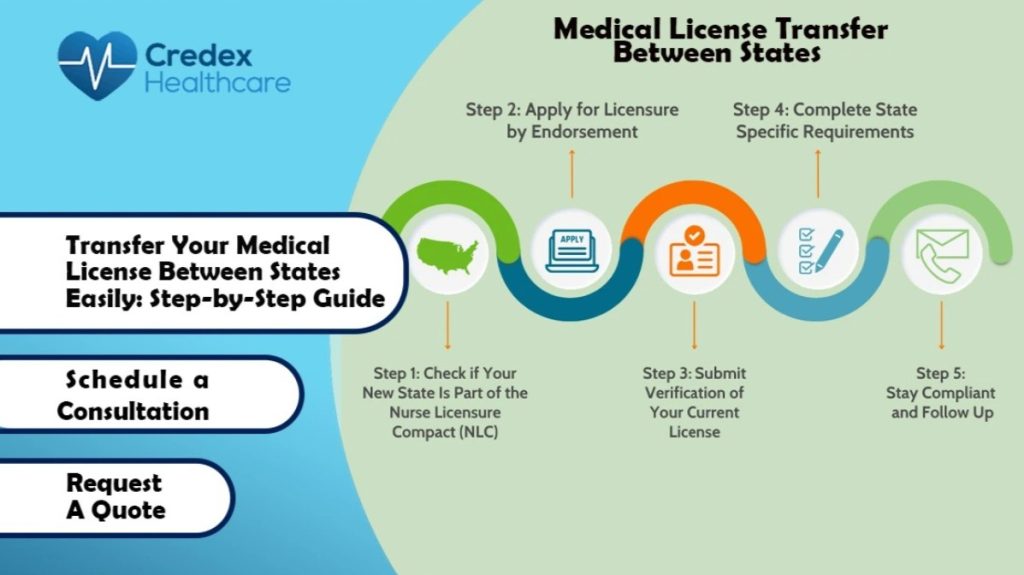
Step-by-Step Process to Transfer Your Medical License Between States
Step 1: Eligibility Check
Before any application work begins, confirm that you meet the destination state’s licensing requirements and, if applicable, the IMLC eligibility criteria. International medical grads, physicians who have been in trouble with the law before, and physicians whose main license is in a state that is not a Compact state must go through different processes than U.S.-trained physicians in Compact member states with clean records.
Step 2: State Medical Board Application
Fill out the legal permit application for the target state. These forms ask for information about your personal history, schooling and training, test records, previous license history in all states where you’ve been licensed, history of disciplinary actions, and permission for a background check. Each part needs to be filled out correctly.
Step 3: Document Verification
The state board uses primary-source verification to check your qualifications on its own. This means that your medical school will directly confirm your degree with the board, your residency program will confirm that you have finished, and every state where you have or have had a license will confirm that you are registered.
Step 4: Background Check
Part of the normal registration process is getting a criminal background check from the FBI or a state body. Fingerprints must be turned in, and depending on the state, they can be submitted in person or by mail.
Step 5: Fee Payment
Application fees are very different from state to state and are usually not refunded, no matter what happens with the application. On top of the state board registration fees, there are fees for background checks, verifications, and handling by the IMLC.
Step 6: Review and Approval
The board reviews the application once the entire file is put together and checked. During the review process, boards can ask for more details. Getting back to those questions quickly keeps the program going. After final approval, a license is issued with an expiry date, and the need to update it starts right away.
Requirements for Medical License Transfer
The set of documents needed to transfer a medical license from one state to another is the same for most state boards, with some adding their own requirements.
- You need a medical degree and proper documents from the issuing academic institution.
- For all steps, USMLE scores must be sent straight from the FSMB or through FCVS.
- Proof of residency training must come straight from the school.
- Depending on the state, the standard set of documents includes a work history spanning the last 5 to 10 years, information on any malpractice insurance claims or payouts, a DEA registration certificate, and a government-issued ID.
- Depending on the rules of the target state, physicians with gaps in their clinical practice, a history of malpractice claims, past board investigations, or training from schools outside the U.S. may need it.
How Long Does a Medical License Transfer Take?
In states that process applications quickly, the standard state board application process for an interstate move takes 6 to 12 weeks for simple applications. In states that process more applications or have more complicated review requirements, the process can take up to 4 to 6 months.
This is sped up a lot by the IMLC’s fast-track route. Physicians who are eligible and apply through the Compact usually receive their licenses in partner states two to four weeks after their applications are processed. The unified verification process of the Compact gets rid of unnecessary calls for verification from different states. This is where most of the time savings come from.
The difference between standard processing and IMLC processing can add months to the entire portfolio for physicians who oversee licenses in three or more states at the same time.
Cost of Transferring a Medical License Between States
Application Fees: The fees that medical boards in different states charge for applications range from about $100 to $900. This difference is big enough that the way fees are set can change the order of multistate applications for physicians trying to stick to a budget.
Verification Fees: If FCVS is used, the first portfolio of credentials costs between $350 and $500. Subsequent state verifications using the same portfolio cost less each time. The prices that different schools charge for direct primary-source checking are different.
Background Check Fees: These vary by state and can be anywhere from $40 to $100. Individual state fees are not included in the IMLC entry fees. These fees are for the management planning that the Compact offers.
Total Costs: In total, it costs between $500 and $1,500 for a single-state move, which includes all paperwork and fees. Transfers between multiple states handled by the IMLC usually cost less per state than similar applications handled individually by each state.
Common Challenges and How to Avoid Them
Documentation Delays
It happens most often and can be avoided most easily, but it does cause deadlines to be pushed back. Certificates of good standing usually expire 90 days after they are issued. This means that they need to be sent close enough to the due date so that they are still valid when the board gets them, but far enough ahead of time to arrive before the due date.
Eligibility Problems
It happens most often when physicians haven’t checked to see if the patient is eligible for the Compact before starting the IMLC application. Not being able to apply due to a license limit in the primary license state, an open disciplinary issue, or an expired DEA registration stops the process before it even begins. If you make sure you are fully qualified before starting the process, you will not waste time or money on an ineligible application.
Incomplete Applications
If the application goes out before all checks are complete, the board should send out failure notes that restart certain parts of the review process. Before submitting, these are always caught when a full pre-submission plan is compared to the standards of the individual state board.
Tips to Transfer Your Medical License Faster
Use the IMLC Pathway If You Qualify
If you are eligible, use the IMLC method. For physicians who are qualified, it is the most effective way to shorten the time it takes to get licensed in multiple states, and its member states now cover most of the country.
Pre-Plan Your Document Collection
Start gathering your documents four to six weeks before you need to turn them in. Certificates of good standing, primary-source verifications, and residency program letters all come from third parties, and once you ask for them, you can’t change when they respond.
Select States Intentionally
If you have the freedom to choose, pick the states carefully. In general, some state boards take four to six weeks to process applications, while others take three to four months. Processing speed can be a valid factor in ordering if time is more important than location in each scenario.
Partner with Professional Services
If you must deal with multiple states, a tight timeline, or a complicated work background, you should use a professional licensing service. Coordinating and following up on multiple applications at the same time takes more time and effort than most physicians can manage while also doing clinical work.
How Credex Healthcare Can Help with Your Medical License Transfer?
Physicians applying for licenses in more than one state can get help from Credex Healthcare from start to finish of the medical license transfer process. The first step is a free meeting to look at your current licensing situation, make sure you are eligible for IMLC if needed, and find the quickest way to get licensed in the places you want to work.
From there, the Credex Healthcare team collects documents, starts calls for source verification, prepares and reviews applications before sending them in, keeps track of their progress with state boards, and answers questions from boards on your behalf. When physicians use Credex Healthcare, they don’t have to deal with the problems of coordinating paperwork and missing follow-ups that often cause self-managed applications to take months longer than expected.
Whether you need a single license transferred quickly for a new employment start date or a multi-state licensing portfolio built for a telehealth platform, Credex Healthcare handles the administrative process, so you don’t have to.
Frequently Asked Questions
Can I transfer my medical license directly from one state to another?
There is no single transfer method in the U.S. Each state has its own mechanism for issuing licenses. What physicians usually mean by “transfer” is asking for a new license in a different state using credentials that they already have. This process is made easier for physicians who are qualified in member states by the IMLC.
How long does a medical license transfer between states take?
Standard state board handling takes six to twelve weeks for full applications in states that process them quickly, and up to four to six months in states that process a lot of applications. Most IMLC applications for physicians who are qualified are processed in 2 to 4 weeks in member states.
What does it cost to transfer a medical license between states?
The total fees in each state usually run from $500 to $1,500. These fees cover the application, proof, and background check. IMLC programs often lower the cost per state for payments between states because they share verification infrastructure, which cuts down on fees that would otherwise be charged twice.
Do all states participate in the Interstate Medical Licensure Compact?
As of 2026, most U.S. states are part of the IMLC, but not all. When physicians in non-member states want to get licensed, they must follow the normal state board registration process. An important first step is to make sure that the target state is part of the Compact before starting the IMLC application.
Conclusion
Most physicians can handle the process of transferring their medical license from one state to another, but it works best when they are well-prepared and worse when they start at the last minute. Timelines for document submission, state board handling, and meeting IMLC standards must all be thought through before the application starts, not after.
The IMLC’s fast-track method is the best way for physicians to shorten the time it takes to get licensed in multiple states. For people who don’t qualify or are applying from a non-member state, getting professional support is the best way to avoid mistakes in paperwork and missed follow-ups, which can make the process take months longer.


