Skip to content
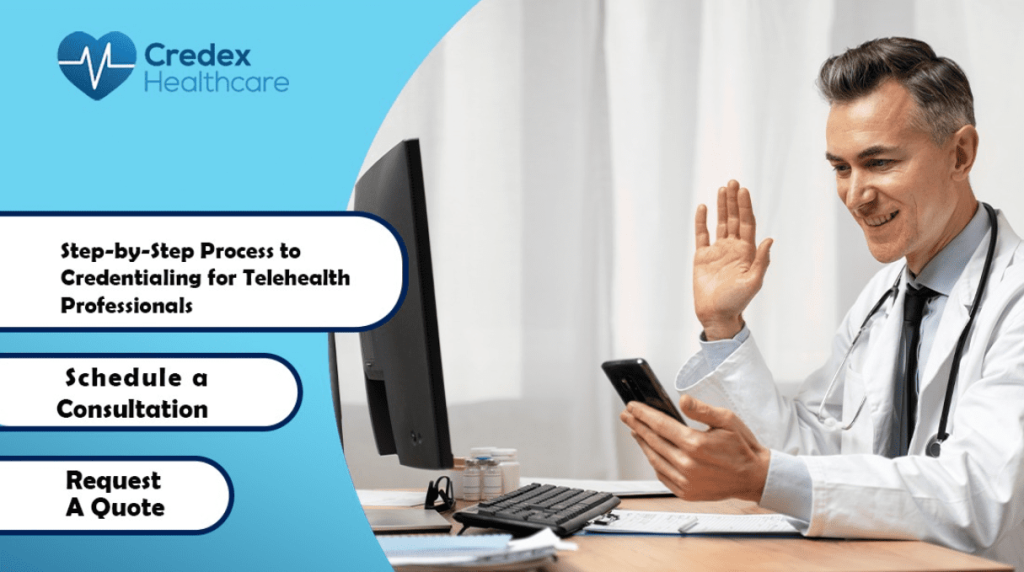
Key Takeaways
- Telehealth credentialing is crucial to legitimize the medical practice of telehealth providers and practices amid rising demand for remote healthcare.
- Credentialing for telehealth services follows a step-by-step process, with distinction that comes from HIPAA compliance and multi-state licensure.
- Telehealth credentialing could make use of outsourced credentialing services to expedite the process, support the IMLC pathway, and reduce recurring credentialing errors.
Why Credentialing is Crucial for Telehealth
Telehealth has revolutionized healthcare by reducing geographical barriers and improving access to quality care, strengthening the healthcare system. For example, a psychiatrist offering virtual consultations to patients across the country or a primary care doctor managing chronic conditions over the phone shows how this industry has become an important aspect of modern medicine.
However, with this opportunity comes responsibility. To provide care with utmost compliance and credibility, telehealth clinics and providers must undergo a credentialing process that verifies their credentials, licenses, and compliance with state and payer regulations.
Credentialing ensures providers meet all requirements before they begin providing remote care. Without it, insurance claims from telehealth providers may be denied, eroding patient trust or even leading to lawsuits. To equip you with the right know-how, this blog follows a step-by-step credentialing process that provides an overview of the entire telehealth credentialing experience, including the initial requirements and sustainable maintenance.
Step 1: Understand Telehealth Credentialing Requirements & Regulations
Telehealth providers should understand the regulations that apply to them before they embark on the complex telehealth credentialing process.
Main Considerations
- State licensing laws: You must be a holder of a valid license in the state where the patient is physically located during the encounter. This means you need multi-state licensing if you work with patients scattered across different states.
- Payer requirements: Medicare, Medicaid, and other insurance providers all have different credentialing requirements for telehealth. Additionally, some commercial payers may need telehealth-specific forms or proof of HIPAA compliance.
- Telehealth modality requirements: Some states require additional documentation or technical standards for certain modalities, such as video/audio visits, asynchronous, or remote patient monitoring.
- Pro Tip: Before you start, check updates and the latest bulletins from the Federation of State Medical Boards (FSMB) and the American Telemedicine Association (ATA). This helps you avoid incomplete or inconsistent applications.
Step 2: Gather Necessary Documents
Credentialing is a paper-heavy task. There is no excuse for you to prepare a bunch of documents, but doing so ahead of time can save you weeks’ worth of back-and-forth.
Common Required Documents
- Individual active state medical licenses or IMLC clearance
- DEA registration to prescribe controlled substances
- Specialty and board certifications
- Diploma or certificate of graduation from medical school and residency program
- Peer references and/or supervisory letter
- Comprehensive CV (employment gap explainer, if applicable)
- Malpractice insurance coverage
Step 3: Complete & Update CAQH Profile
Maintain accurate credentials by checking the Council for Affordable Quality Healthcare (CAQH) ProView (now DataSpring), a centralized database that most insurance companies refer to obtain provider information.
CAQH Steps to Follow
- Register for CAQH ProView.
- Complete the correct personal, professional, and practice-specific details.
- Upload supportive credentialing paperwork (licenses, malpractice insurance, diploma, etc.).
- Authorize payers to access your CAQH profile.
Keep your CAQH profile up to date. It is now required for every provider using CAQH/DataSpring to re-attest their profile every quarter. Not updating your information or renewing an expired credential can cause delays or denials.
Step 4: Apply for Multi-State Licensure
Assuming you want to expand your patient base across multiple states, you must obtain licenses in all the states where you plan to practice. Fortunately, in most cases, telehealth providers lean on programs like the Interstate Medical Licensure Compact (IMLC) to simplify this licensure pathway. In 2026, 44 states are members of the IMLC, fast-tracking the way licensure is obtained for telehealth providers in the U.S.
The Reason this Matters
- You are not legally allowed to treat patients in that state unless you comply with the applicable state regulations.
- Some states offer interim or emergency telehealth licenses, but only for a limited time.
Licensing regulations vary by specialty and differ across allied health professionals, such as nurse practitioners, mental health counselors, and others. Always double-check qualification requirements with each state’s licensing board.
Step 5: Submit Applications to Multiple Payers
After you successfully obtain your licenses and CAQH attestation, it’s now time to join payer networks. This will be the final step before you submit insurance claims for telehealth services.
Standard Payer Enrollment Process
- Select payers with whom you wish to contract. Because there are hundreds to choose from, select a payer based on your criteria.
- Submit applications to each payer using their specific or universal forms.
- Gather all enrollment documents.
- Submit any forms or attestations for a particular telehealth service.
Different payers work on their own credentialing timelines. Typical approval window periods range from 60 to 120 days, and extensions can take longer than expected. To avoid mix-ups, maintain a personalized tracker that monitors submission date, status, and actions taken.
Step 6: Ensure HIPAA & Training Compliance Standards
Telehealth poses unique privacy and security risks. That is why HIPAA compliance should not be an afterthought. Most states and payers bar uncredentialed providers from enrolling in their panels if their documents lack HIPAA training. Specifically, providers may be required to provide evidence of:
- HIPAA compliance training: The capacity-building training may center on topics such as PHI management, telehealth privacy and security, and the Minimum Necessary Standard (MNS) protocol.
- Use secure, encrypted teleconferencing tools.
- Follow secure data-storage and access protocols for patient health information (PHI).
Step 7: Monitor Application Status
Even when you think your documentation is spotless, delays still happen. Missing signatures, outdated licenses, or obsolete work history notes can affect your application’s turnaround. Consistent follow-up deters delayed approval, as passive waiting can extend the wait by months.
Best Monitoring Measures
- Follow up with payers every 2-3 weeks for progress.
- Immediately respond to correspondence regarding additional information requests.
Step 8: Keep Credentials Updated
Credentialing may look complete once you are ready to enroll with a payer, but it is not a one-time project.
Failure to renew credentials may result in outright suspension of payer network participation. During the credentialing process, providers must use a credentialing calendar to track expiration dates for:
- State licenses
- DEA registration
- Malpractice insurance coverage
- Board certifications
Common Telehealth Credentialing Mistakes to Avoid
- Failure to obtain the required state licenses results in immediate rejection.
- Mismatched CAQH profiles and other minor errors lead to resubmissions and application denials.
- Overlooking payer-specific forms of telehealth by using generic forms.
- As credentialing requires ongoing attention and follow-up, passive waiting only prolongs the process, as credentialing cannot be left unattended.
Why Many Telehealth Providers Use Credentialing Services
The credentialing process may take 3 to 6 months, depending on payer mandates and the current insurance landscape, and errors or unexpected circumstances may extend the window further. Many telehealth providers subscribe to telehealth credentialing services to gain perks and advantages, such as:
- Expedited applications and payer enrollment
- Reduce rejections
- Fast-track multi-state licensing
- Manage ongoing recredentialing cycles
For busy professionals starting a telehealth practice, outsourcing is proven to be faster and involves less administrative workload on your end.
Conclusion
A dedicated and compliant telehealth practice is built on proper credentialing. Whether it is a simple document review or a quick compliance audit, each step is worth taking to safeguard the interests of both patients and providers.
An efficient credentialing process not only speeds up approvals; it also lets providers spend more time providing quality care instead of attending to paperwork. Credentialing bridges telehealth providers and patients who need their care, fostering long-term trust and ensuring industry compliance.
FAQs
How long does the telehealth credentialing process take from start to finish?
The average credentialing window is 60-120 days; however, multi-state licensing may take longer, and expect slow response times from some payers that lack a standard feedback loop.
Can one credentialing application be used for multiple states?
No. Every state requires a specific license to practice telehealth, but undergoing multi-state licensing programs, such as the Interstate Medical Licensure Compact, can fast-track the application.
What documentation is required for telehealth credentialing?
To qualify for this process, you need to secure the following documents: licenses, malpractice insurance, medical school diploma, CV, DEA registration, and evidence of using HIPAA-compliant systems and technology.
Are HIPAA training requirements different for telehealth providers?
Yes. Providers must have current HIPAA training on telehealth PHI handling and data security protocols.
Simplify telehealth credentialing with expert support
Contact Credex Healthcare’s medical credentialing services today