Skip to content
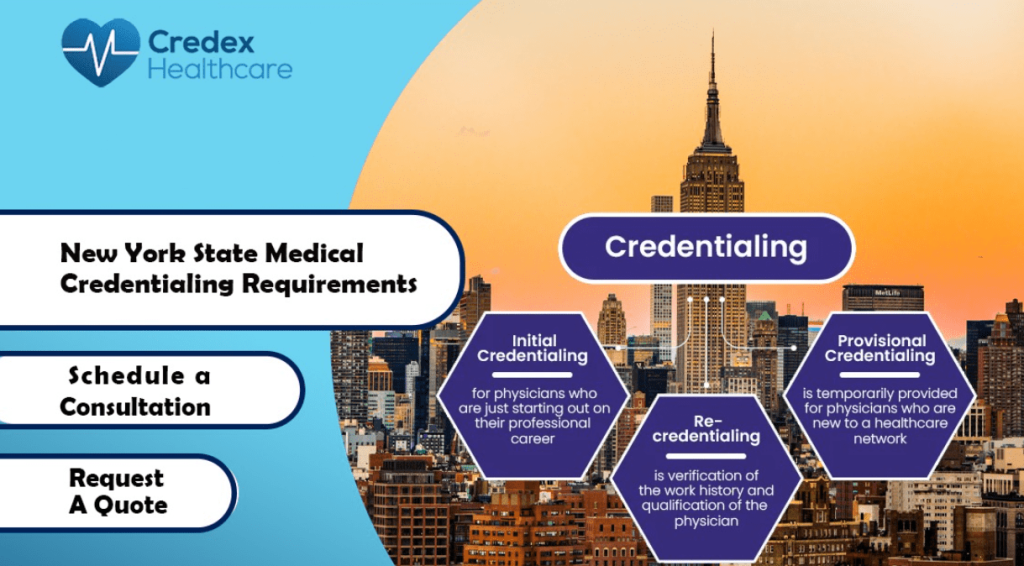
The standards for getting a medical license in New York State are among the strictest in the country. This state has one of the highest participation rates for Medicaid managed care in the US. It also has strict NCQA and AAAHC approval standards, and providers have to go through both the state registration process through eMedNY and different licensing steps with each MCO they want to bill. Any mistake on that list will cause your start date to be pushed back and your income to be held up.
This guide explains what New York really needs, where providers often struggle, and how the process works, from gathering documents to securing funder approval. The details here are the same whether you are licensing a new doctor, a nurse practitioner, or a whole group practice.
Why New York Credentialing is Different from Other States
Most states put most of their attention on payer licensing, which is the process of getting approved to bill for services through private insurance and government programs. That’s also what New York does, but it adds standards for approval that other states don’t have. A lot of healthcare organizations in New York must meet NCQA or AAAHC standards. This means that checks of credentialing files can happen at any time. An inspector can randomly ask for any provider’s credentials. If something is missing or out of date, the practice will be given a finding.
Also, New York changes the number of licenses every year, whereas most states do so only every 2 or 3 years. In New York, NPDB (National Practitioner Data Bank) searches, background checks, and checks for fraud are usually done once a year instead of just when someone gets their first credential or renews their credential. Most companies don’t expect to have to do as much regular upkeep when they move into the state.
There is also need for a paper application for eMedNY. More than half of New York’s business payers use digital platforms like Availity. However, New York Medicaid still receives registration forms through the mail. Just that adds 2-4 weeks to the Medicaid process before the review even starts.
New York State Medical Credentialing Requirements: Complete Document Checklist
The list of documents below includes what New York payers, such as eMedNY, large commercial carriers, and hospital privileging panels, usually need. The most common reason for refusal or delay is that items were missing or out of date when the application was made.
A valid, up-to-date New York State professional license from the New York State Education Department (NYSED)
A DEA registration document, which is needed for doctors to write prescriptions for banned drugs
A copy of your current liability insurance card that shows when and how much it covers
A resume in month/year style with no gaps longer than 30 days that can’t be explained
Board approval (if it applies to the provider’s field)
Current proof of hospital privileges (if needed)
Copies of medical school diplomas and residency achievement certificates
A picture ID from the government, like a driver’s license or passport
W-9 form with up-to-date tax details
Individual NPI (Type 1) and group/organizational NPI (Type 2, for practices that bill as a business)
CAQH ProView profile (fulfilled, certified, and within 120 days of the next attestation)
NPDB self-query report (most NY groups need this every year, not just when you first get your credentials)
Important: Papers due in less than 30 days are often turned down right away. If you need to renew something soon, do it before you send it instead of after you get the rejection letter.
The eMedNY Enrollment Process for New York Medicaid
eMedNY is the computer Medicaid record system for the New York State Department of Health. It is also where all New York Medicaid providers sign up. eMedNY is different from most commercial insurance platforms in that most registration types still need a paper application to be mailed in. Because of that one step, New York is not yet, unlike digitized states like California (Medi-Cal Provider Enrollment) and Texas (PEMS), which have already done so.
Sign up for an eMedNY account as a provider and choose the right service type group.
Fill out the paper registration form that is special to your source.
Get all the necessary supporting documents and attach them.
Send the application by mail to the eMedNY address listed for your type of provider.
Keep an eye out for letters requesting additional material or information.
Get proof of admission and registration of NPI in the eMedNY system.
eMedNY Enrollment Timeline
eMedNY takes 60 to 120 days to process, and it may take longer if fingerprinting and security checks are needed. There are stricter rules for some types of providers, like DME suppliers, home health agencies, and mental health workers who bill under Article 31 or Article 32. More monitoring is put on DME workers in particular, which can make deadlines even longer.
One important thing that many providers miss is that signing up for eMedNY does not give you access to New York Medicaid Managed Care. In New York, each MCO (managed care organization) has its own process for hiring and approving people. If a provider wants to bill WellCare, MetroPlusHealth, Healthfirst, Fidelis Care, or any other MCO, they still need to apply to those plans individually. That’s a different verification process for every plan.
CAQH ProView Requirements for New York Commercial Payers
Most business payers in New York use CAQH ProView to check the qualifications of providers. Aetna, UnitedHealthcare, Cigna, Empire BlueCross BlueShield, and most other big companies get their info straight from CAQH instead of asking for different documents. In other words, your CAQH page needs to be full, correct, and up to date before any of those apps can move forward.
Every 120 days, you need to re-attest for CAQH ProView. If you miss the re-attestation time, the profile is no longer valid from the payer’s point of view, even if all passwords are still valid. Payers can’t see a page that hasn’t been confirmed, and they won’t wait while you re-attest. The app stops working until the profile is ready to be used again.
CAQH management is where a lot of work piles up quickly for multi-specialty group offices or any company that is in charge of multiple doctors’ credentials. Each service has its own certification plan, and they don’t all line up easily. When you’re keeping track of 10 providers, you have 10 different 120-day windows. If one of them expires, it can stop a live payment application.
NY-Specific Credentialing Challenges Providers Get Wrong
CV Gaps and Work History Format
New York payers need a CV with a work history that is organized by month and year, with no breaks longer than 30 days that aren’t explained. A CV will be reported if it says “2019-2022” for a job duration without months. It is important to keep clear records of all activities during gap years, such as locum tenens jobs, internship years, study roles, and anything else. This rule is tougher in New York than in most other states, and it includes providers who have sent the same CV to other states without any problems.
Malpractice Insurance Timing
Malpractice coverage must be active for the entire period under review, not just the submission. Providers whose coverage lapsed and was reinstated may face additional documentation requirements explaining the lapse period. If your malpractice certificate expires within 30 days, renew first and submit the updated certificate. Submitting a near-expiration certificate creates a timing problem that generates rejection on an otherwise complete application.
NCQA Recredentialing Cycles
New rules from NCQA for 2025 require groups that share credentialing to do original source verification within 90 days, down from 180 days before. According to NCQA rules, recredentialing cycles happen every three years. However, New York organizations add yearly update requirements on top of that, which means files need to be actively maintained between official recredentialing cycles. When providers think their credentials are taken care of until their next recredentialing date, they often find out they weren’t when they are surveyed without warning.
Behavioral Health Credentialing Complexity
Mental health and substance use providers in New York have to follow additional rules. For providers with more than one license type, like an LCSW who is also an LMFT, billing under Article 31 (mental health) and Article 32 (chemical dependence) programs often needs different CAQH profile setups because they must meet supervision ratio standards. For some users, each type of license may need its own set of credentials.
Typical New York Credentialing Timeline
In New York, most business provider identification is completed within 45 to 90 days if all necessary paperwork is sent in on time. It takes between 60 and 90 days for the medical staff office to review hospital privileges, which is a separate process. It takes an extra 60 to 120 days to sign up for eMedNY Medicaid and an extra 45 to 90 days per plan for MCO-specific licensing.
For a new doctor starting a multi-payer practice in New York, the entire credentialing process could take 90 to 150 days from the time all paperwork is turned in. This includes all the payers. Most of the time, providers who start seeing patients before they are officially enrolled with a payer can’t bill that payer for services that were already provided. That has nothing to do with bills. It means revenue loss.
The single most important thing that practices can do to control the schedule is to start the process when the hire is made, not after training is done. The second most important thing is to send in a complete application the first time.
How Professional Medical Credentialing Services Handle New York
Credentialing firms that do a lot of work in New York have made payer-specific checklists, made contacts at eMedNY and the big MCOs, and keep an eye on changes NCQA makes to the paperwork requirements. That institutional knowledge shortens cycles because applications that are full and correct move faster than those that need more information.
The New York Medicaid and MCO processes are where professional help pays off the most for a business that handles licensing itself. eMedNY paper entries need to be formatted and mailed in a certain way. For MCO credentialing, each plan needs its own entry process and follow-up periods. Both take a lot of time and need correct, up-to-date information about each customer’s needs.
Credex Healthcare handles all aspects of medical credentialing in New York State, such as eMedNY registration, CAQH profile management, MCO-specific credentialing, and ongoing re-credentialing. Get in touch with us to talk about the schedule and what it takes to get your providers billing-ready in New York if you are adding new providers or dealing with registration gaps.
Frequently Asked Questions
How long does medical credentialing take in New York?
For most doctors, getting credentialed by a commercial company takes 45 to 90 days when all necessary paperwork is sent in on time. Signing up for Medicaid through eMedNY adds 60 to 120 days. For each managed care plan, the MCO-specific licensing process takes an extra 45 to 90 days. The two best ways to cut down on the time it takes are to start at the time of hiring and send in full applications the first time.
What is eMedNY and why does it matter for New York providers?
eMedNY is the system used by the New York State Department of Health to sign people up for Medicaid. If a provider in New York wants to claim Medicaid, they must sign up through eMedNY. However, this enrollment does not apply to Medicaid Managed Care plans. For each MCO, a unique certification application is needed. Most types of providers still must send their information to eMedNY by mail, which makes the working time longer than in states where Medicaid registration is done digitally.
Do I need to credential separately with each Medicaid MCO in New York?
Yes, enrolling in eMedNY and getting an MCO license are two different steps. By signing up for eMedNY, you do not automatically become a member of WellCare, Healthfirst, MetroPlusHealth, Fidelis Care, or any other New York managed care organization. There are different ways to get credentials and sign contracts with each MCO, so you have to apply to each plan separately.
How often does CAQH ProView need to be re-attested in New York?
Every 120 days, CAQH ProView needs to be re-attested. Payers can’t see the profile if a declaration has passed, even if all the details inside are still valid. Any current client forms that depend on CAQH access will be held up if the re-attestation deadline is missed. Each provider has their own certification plan that needs to be kept track of separately by group offices that manage more than one provider.
What makes New York medical credentialing harder than other states?
Three things. First, New York is stricter on licensure than most states. Many healthcare organizations are required by NCQA and AAAHC to update their files once a year instead of every 2-3 years, as is normal. Second, you can’t join in eMedNY online; you must send in a paper form. Third, each Medicaid Managed Care MCO has its own credentialing application. This means that a provider who wants to join New York Medicaid must go through more than one credentialing cycle, not just one state registration.
Get started with expert support
Contact Credex Healthcare’s medical credentialing services today