Skip to content


Key Takeaways
- Full RCM usually runs on the agreed % of collections. That’s more than billing alone, because it covers the whole cycle.
- Four things move the price most: specialty, claim volume, payer mix, and scope.
- Cost to collect gives you the cleanest view of what your revenue cycle really costs, in-house or outsourced.
- RCM pays for itself once better collections and fewer denials outweigh the fee.
- It’s hard to compare how much revenue cycle management costs. Why? Different sellers never give the same scope. One proposal checks to see if the patient is eligible, gets prior authorization, and bills the patient. The other proposal only handles claims and denials and charges extra for the rest.
That being said, a lower percentage doesn’t always mean a lower bill. If the quote is cheap but doesn’t include prior authorization, it may end up costing more than one that does. This is because you still have to pay for staff time. Find out first what each quote means. Second, compare the numbers.
In this blog, we explain what full RCM includes, how prices are usually set, what makes prices go up, and how to measure value. Already comparing vendors? Put Credex Healthcare’s revenue cycle management services on your list too.
What’s Included in Revenue Cycle Management (and Why It Costs More Than Billing Alone)
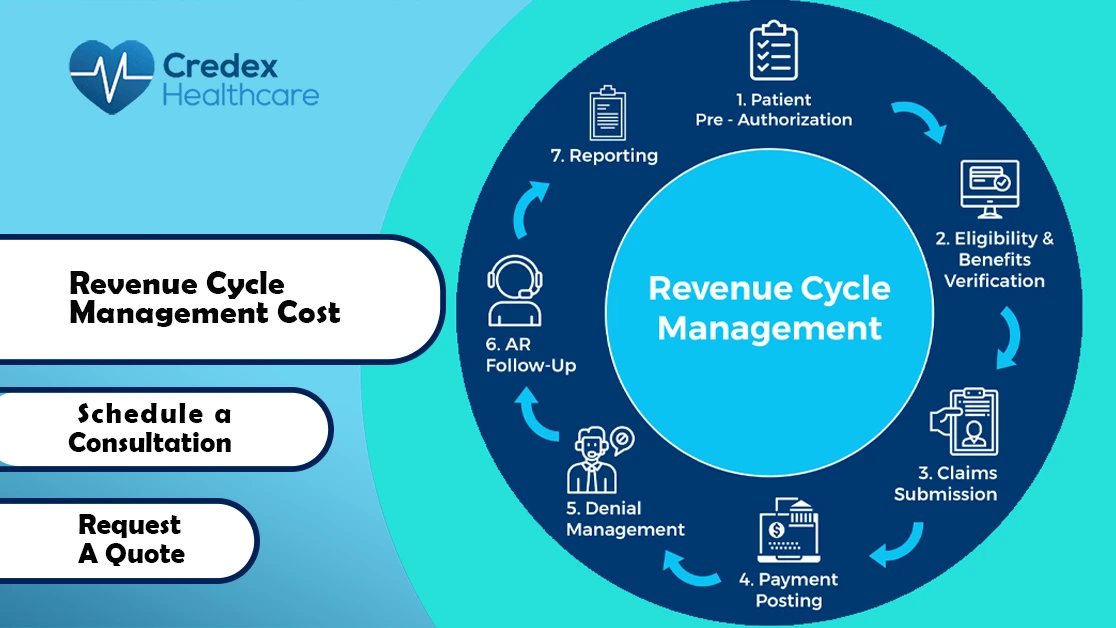
Full RCM starts when a patient books an appointment and ends when the last payment is made. A lot of sellers break that up into three steps.
Front-end RCM includes scheduling help, making sure people are eligible, and getting permission ahead of time. When you get these wrong, rejections start to pile up. This stage keeps everything that comes after it safe
Mid-cycle RCM includes charge capture, medical coding services, and clean claim submission. This is what most people think of when they think of medical billing services.
Back-end RCM covers payment posting services, managing denials, following up on outstanding debt, and billing patients. Credentialing, analytics, reporting, and EHR integration are all part of a lot of full RCM contracts.
Most of the time, billing-only service ends when the claim is paid. The higher fee reflects the front-end work and reporting included in full RCM. It also saves your staff time. Read our post on the difference between medical billing and RCM to get a better idea of what we mean.
How Much Does Revenue Cycle Management Cost?
Revenue cycle management fees follow four main models. Here’s how they compare for physician practices in 2026.
| Pricing model | Typical range | Best for |
| Percentage of collections | [owner-approved %] of monthly collections | Most practices; fees rise and fall with revenue |
| Per-claim fee | [owner-approved $] per claim | High-volume, low-complexity claims (see medical billing rates per claim) |
| Flat monthly fee | [owner-approved $] per month or per provider | Stable volume and predictable budgets |
| Dedicated staff (FTE) | [owner-approved $] per FTE per month | Large groups and facilities wanting a dedicated team |
Setup fees are also important. Contract minimums and one-time projects to clean up AR also matter. These all affect RCM pricing. When it comes to hospitals, prices are usually based on the number of beds or the net income from patients.
Do you only need help with claims and denials? Then look at how much medical billing services cost to see prices for just billing. Full RCM costs more, but it might be able to replace the front desk and clearance staff that you pay for now.
The risk is split between you and the seller in different ways. Part of their pay depends on how well you do, while a flat fee lets you know what to expect. Our comparison of percentage-based and flat-fee pricing models shows which works best for each business.
Want a quote based on your claim volume and specialty?
Consult with Credex Healthcare today to get clear pricing that fits your needs and discuss your RCM needs.
What Drives RCM Pricing
There are times when two practices make the same amount of money but get very different rates. Seven things account for most of that gap.
- Specialty complexity. There are more codes, modifiers, and authorizations for cardiology, orthopedics, and oncology than for primary care. More work per claim means a bigger fee. Surgical fields track periods around the world, so each follow-up visit requires more review.
- Claim volume. As more claims come in, the fixed setup costs are spread out over more claims. That’s the reason the number falls so often. Practices that are very small usually only meet once a month.
- Payer mix. It’s more important to follow up on Medicaid, workers’ comp, and out-of-network claims than on business claims. And when a patient is responsible for a lot of things, they get more bills and collection calls.
- Scope. The price changes for each service you add. On top of that, patient billing and coding checks, prior permission, identification, and payer registration are often offered as extras.
- Technology. There are companies that work with your EHR. Some people want you to be on their site. Setting up can cost more if you need interfaces, integration work, or reporting dashboards.
- AR backlog. Months of claims that haven’t been worked? You can expect a separate cleanup fee or a higher rate for old AR. Older claims take more calls and appeals to recover a dollar.
- Practice vs. hospital. These two types of facilities have different rules for billing and staffing needs. As a result, their contracts look different.
Cost to Collect: The Metric That Shows What RCM Really Costs
What does it cost you to bring in one dollar? That’s the cost to get it. According to the HFMA MAP Keys, it is the total cost of the revenue cycle divided by the total cash received from patients.
There are many things that make up the total cost of the revenue cycle. These include salaries and benefits for billing and front desk staff, vendor fees, billing software, clearinghouse fees, statements, and postage.
Assume that a practice spends $18,000 a month on its revenue cycle and makes $400,000 a year. To get it, it costs $18,000 ÷ $400,000, which is 4.5%.
You get two things when you track it. You can compare the costs of in-house revenue cycle management versus third-party management. You can also check every month to see if your RCM spending is getting you what you paid for.
Pay more attention to the trend than to the exact number. Your revenue cycle is getting shorter if the cost to collect goes down while collections stay the same. You’re paying more for the same thing if it goes up, but collections stay the same.
Check every month. Every time, use the same cost groups. If you change what you count, the trend will be thrown off.
Don’t count the costs of care. Even if hospital staff help with paperwork, nurse time, exam room materials, and doctor pay are not revenue cycle costs. They make any seller look cheap because the number of them grows as you count them.
In-House vs. Outsourced RCM: The Cost Comparison in Brief
In-house RCM is more than just paying salaries. It also includes benefits, software licenses, clearinghouse fees, training, office space, and the cost of people taking time off and leaving.
When you outsource, most of that is rolled into one fee. But some internal costs stay the same, like the front desk staff and the person who handles the provider.
Most people forget about the cost of coverage. A vendor takes on the risk that claims will stop when your only biller quits or goes on leave. Even if the regular fees look close, it’s worth something.
Compare how much it costs you to collect on your own to how much it costs the seller plus any other costs you have. See how to figure out the real cost of billing in-house vs. outsourcing for the full worksheet. It goes over every cost line with an example.
How to Compare RCM Quotes
Begin with a billing audit. Without a baseline, you can’t tell whether a vendor’s promises beat what you have now.
Then put the same questions to every vendor:
- What’s included? Get front-end, mid-cycle, and back-end services listed in writing.
- What does setup cost? Ask about onboarding, data migration, and AR cleanup fees.
- Is there a minimum? Lots of contracts carry a monthly minimum fee or a minimum term.
- How long is the contract? Check the notice period. Also check what happens to your data when you leave.
- What will you report? Monthly collections, denial rate, days in AR, and net collection rate, at minimum.
- Which KPIs will you commit to? A vendor that trusts its own work will put targets in writing.
Put all of the answers into a single worksheet so that the areas match up. Also, review the hidden costs before you sign, so there are no shocks in month three.
When RCM Pays for Itself
Simple Rule: RCM pays for itself when the money it gets back exceeds the fee it charges. Usually, that gain comes from fewer turns down, faster payments, and fewer write-offs.
Run the Math: For every extra point of net collection rate, you can collect $10,000 more. When you compare that to the fee, you’ll find the point where your practice breaks even.
AR and Denials: Do the same thing for days in AR and denials. Getting half as many claims denied, and all of them paid on the first try, saves time and cash flow. When AR days are shorter, you get paid faster, which supports practice growth and payroll.
Denial Root Cause: Denials are usually the quickest win. If you fix the reasons medical billing is often denied, you can recover money you’ve already earned. Faster follow-up on AR then keeps cash flow steady.
Average Recovery Rate: Check out the average rates of medical debt recovery by field. When you’re way below the benchmark, the gap is usually bigger than any RCM fee.
FAQs
How much does revenue cycle management cost for a small practice?
Small practices generally pay an agreed % of monthly collections, but some sellers require a minimum monthly payment. RCM price for small offices depends mostly on the number of claims, the specialty, and the scale of the work. Adding prior authorization, credentialing, or patient billing increases the cost.
Is revenue cycle management more expensive than medical billing?
Usually, yes. Full RCM includes more than just claims. It also includes things like eligibility, prior authorization, credentialing and payer enrollment, patient billing, and analytics. But it can replace front-end staff and existing software. Do not compare just the top number; compare the total cost, which should include staff you no longer need.
What is cost to collect?
For HFMA, the total cost of the revenue cycle is split by the total amount of cash received from patients. In simple terms, it’s how much you spend to make one dollar. Check it once a month to see if the money you spend on RCM (either in-house or outsourced) is worth it.
Do RCM companies charge setup fees?
Some do. Some people do. Most one-time fees cover things like onboarding, data migration, EHR integration, and cleaning up old AR. This will help you get fair quotes when you compare them. Ask each vendor to write down any setup fees and monthly minimums.
Get a Revenue Cycle Management Quote
Your real revenue cycle management cost comes down to specialty, volume, payer mix, and scope. A solid quote spells out each one. It should also show how your cost to collect will change.
At Credex Healthcare, we price full RCM around your practice, not a generic rate card. Share your claim volume and specialty to get a revenue cycle management quote with a clear list of what’s included.
Want To Get Revenue Cycle Management Quote?
Share your claim volume and specialty with Credex