 Skip to content
Key Takeaways
- Multi-specialty practices juggle credentialing across several provider types at once, which multiplies the paperwork, payer rules, and deadlines a single vendor must track.
- The best credentialing companies for multi-specialty practices handle varied specialty requirements under one coordinated process instead of treating every provider the same way.
- Credex Healthcare tops this list for groups that need a single point of contact managing credentialing across an entire roster of specialties.
- Look past prices alone. Turnaround consistency and how well a vendor scales with new provider additions matter just as much.
- Outsourcing tends to make more financial sense as a practice grows past a handful of specialties and locations.
- Payer rules and CMS requirements change often, so confirm current specifics directly with official sources rather than relying on older figures.
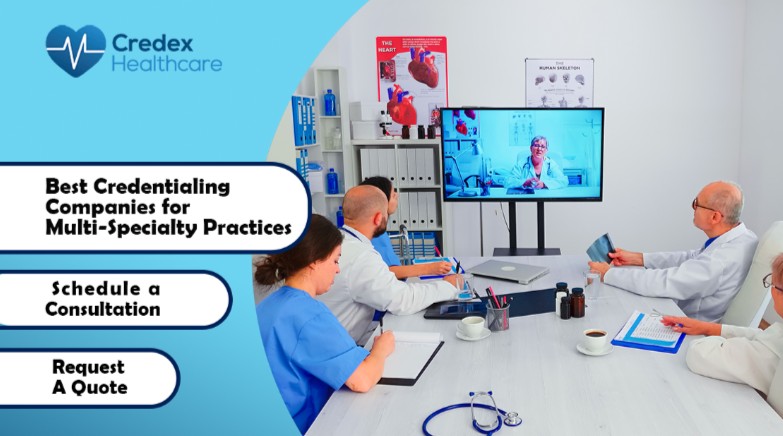
Multi-specialty firms must deal with more licensing work than single-specialty groups. Because it has family medicine, cardiology, and mental health all under one roof, a clinic must deal with different requirements from payers, specialty board checks, and recredentialing timelines for each type of provider, often all at the same time. To find the best credentialing companies for practices that treat more than one type of illness, you need a vendor that can handle all that complexity without falling short in any one area.
This guide talks about the best credentialing companies for multi-specialty groups right now, what you should look for in a contract, and how Credex Healthcare sets up its process for practices with a list of providers from different specialties.
Why Multi-Specialty Practices Need Specialized Credentialing
A practice that specializes in only one area of medicine must follow one set of rules for payers, one type of board certification, and a regular revenue cycle. That’s not an option for multi-specialty groups. When there are three cardiologists, a mental health provider, and a nurse practitioner on the same roster, they are all licensed by different boards, have different reviews of their malpractice history, and sometimes even work with different payer networks.
That level of complexity grows quickly. If you forget one specialty-specific rule, a provider could be out-of-network for months while the rest of the practice bills normally. Patients aren’t sure what their coverage is, the front desk staff has to deal with angry calls, and the office must make up the difference in income. A licensing company that can only handle simple applications from doctors will have a hard time with this.
It’s also easy to underestimate how hard it is to coordinate your movements. When a multispecialty practice adds a new location or specialty line, they must get credentialed by every payer that the new location or specialty works with. This can mean that dozens of applications must be launched at the same time. When a practice is trying to grow, vendors who don’t have set workflows for scaling can quickly become a problem.
The gap is clear in the lack of credentials for mental health professionals. Mental health doctors often must deal with stricter payer rules, extra steps to sign up for telehealth, and special paperwork that a medical group licensing company might not know to ask for right away. When you add three or four fields, each with its own quirks, it’s clear why they need to be handled by professionals.
How We Ranked the Best Credentialing Companies
When ranking credentialing companies for multi-specialty practices, it was important to look beyond general claims about physician credentialing and see if each vendor shows experience in more than one specialty. We checked how many different categories each company has certified, how they handle account management when a practice has more than one type of provider, and how they manage the renewal plan when dozens of providers are on different dates.
The technology was also looked at. Instead of using email chains and spreadsheets to keep track of status, practices that oversee 10, 20, or more providers across multiple specialties would benefit greatly from a central dashboard that shows the status of all applications. The way prices were set was also important, but being honest was more important than the actual cost. Since these details change over time, you should always confirm with each provider directly and cross-check against CMS and CAQH tools to get the most up-to-date price and payer-specific numbers.
Best Credentialing Companies for Multi-Specialty Practices Compared
| Company | Specialty Range | Notable Strength | Best Fit For |
| Credex Healthcare | Broad multi-specialty coverage | Single coordinated team managing all specialties on one roster | Multi-specialty clinics and physician groups of any size |
| PracticeWorx | Provider enrollment across specialties | Acts like an in-house credentialing department | Practices wanting hands-on, dedicated specialist support |
| credentialing.com | Nationwide, all 50 states | Long operating history with thousands of clients served | Practices wanting an established, broad-coverage vendor |
| CredentialMy | Credentialing software and support | Centralized provider data tracking across specialties | Groups that want strong software alongside service |
| Capline Healthcare Management | Multi-specialty RCM and credentialing | Bundles credentialing with billing and eligibility verification | Practices wanting one vendor for billing and credentialing |
| PayrHealth | Payer contracting across specialties | Negotiates payer contracts alongside credentialing | Health systems and larger multi-specialty groups |
| MediBillMD | 60-plus specialty coverage | Provider portal for real-time application tracking | Practices wanting visibility into every application’s status |
| DoctorsManagement | Practice consulting plus credentialing | Broader compliance and operations guidance included | Groups wanting strategic support beyond enrollment alone |
| Access Healthcare | Large-scale multi-specialty RCM outsourcing | High-volume automation for large provider rosters | Health systems adding many providers across specialties at once |
Top Credentialing Companies for Multi-Specialty Practices
Credex Healthcare

Credex Healthcare is at the top of this list because it bases its credentialing on groups with a mix of niche providers instead of using the same template for all of them. Within the same clinic, practices get a coordinated team that knows how to meet the unique needs of behavioral health, cardiology, primary care, and specialty lines. This way, nothing gets lost in translation between departments. This teamwork is most noticeable during recredentialing, when dozens of providers in different fields come up for renewal at different times. Credex Healthcare keeps track of each one’s dates separately instead of letting them blend together.
PracticeWorx

Dedicated licensing experts are assigned by PracticeWorx and stay involved throughout the registration process, making it feel like having an extra staff member working for the practice. Multispecialty groups that want a personal relationship rather than a ticket-based help system tend to choose this model.
CredentialMy

CredentialMy stands out because it offers a unified provider data tool that helps multi-specialty groups keep all their providers’ papers, payment status, and expiration dates in one place, rather than spread out in different practices or files. For practices that must manage complicated schedules with multiple providers, this kind of unified access saves staff time because they don’t have to do as much internal chasing.
Capline Healthcare Management

Capline Healthcare Management combines credentials with billing, eligibility verification, and more comprehensive revenue cycle management. This is appealing to multispecialty groups that want to work with fewer vendors.
PayrHealth

PayrHealth brings both standard credentialing and payer contracting expertise to the table. This helps larger multi-specialty groups or health systems negotiate rates across several specialty lines at the same time.
MediBillMD

MediBillMD covers more than sixty specialties and gives practices a portal for directly checking the status of their applications. This reduces the back-and-forth on the phone that often slows down projects involving multiple providers.
Access Healthcare

Access Healthcare is the last company on the list. It has a large-scale processing capacity designed for high-volume registration, which helps health systems bring many doctors from different fields at once.
Key Features to Look for Before Choosing a Provider
Cross-specialty knowledge should be the first thing looked at, not the last. Ask any credentialing company directly how many different fields they’ve worked with, and don’t just take their word for it that they’ve done a lot. A company whose members are mostly licensed primary care doctors is likely to run into problems with the way mental health or specialty surgery practices record things.
The way your account is set up is just as important. Some sellers give you one point of contact for a whole list of providers across different specialties, while others split providers up among different areas based on specialty. With the first model, there is generally better teamwork and less stuff getting lost because one person knows what the whole practice needs.
As soon as a practice has more than a few sources, technology and reporting skills quickly separate the good ones from the rest. Administrative staff don’t have to keep sending emails to check application status when there is a real-time dashboard that shows where each application is, what documents are still missing, and the next recredentialing deadline.
For multi-specialty practices, the renewal calendar gets complicated very quickly, so credentialing management needs extra care. As different types of providers work on different cycles, it’s important for vendors to have a system that alerts practices to upcoming deadlines before they happen, rather than waiting for practices to notice a breach after the fact.
Clear contracts are the last thing on the list. Find out exactly what is included in the base fee and what costs extra, especially if you want to add new services or locations mid-contract. Because multi-specialty practices change and grow more than single-specialty groups, it’s more important for the contract terms to be flexible here than in other places.
Benefits of Outsourcing Credentialing for Multi-Specialty Practices
A small multispecialty practice with only two or three types of providers and no plans to grow can handle licensing on its own. When a practice opens a second location or adds a fourth or fifth specialty, the internal workload usually grows faster than what one or two staff members can handle on top of their other duties.
There are real benefits to outsourcing that go beyond just getting rid of paperwork. Credentialing vendors can usually handle applications more quickly because they’ve already built ties with and are familiar with major providers. They also have institutional knowledge of specialty-specific requirements that an in-house team would have to learn the hard way, often by having claims denied along the way. This could take months or even years.
Plus, it’s easier to add more users. A well-known vendor already has the process set up for when a multi-specialty practice opens up a new location or hires providers in a specialty it hasn’t worked with before. When speed is most important, an in-house team that has never worked in the field before has a longer learning curve.
Cost is often the first thing practices look at when deciding, but it’s better to think about things thoroughly than to compare a vendor’s monthly fee to a rough estimate of internal costs. In that comparison, you should include salary, perks, training time, and the money that was lost because of delays in getting credentials. When everything is taken into account, outsourcing usually costs less for multispecialty practices that are over a certain size.
Why Credex Healthcare Is a Reliable Choice
Credex Healthcare sees multi-specialty licensing first as an organizational issue and then as a paperwork problem. Credex doesn’t put providers in separate departments based on specialty. Instead, one team is responsible for a practice’s entire roster. This way, the applications for a cardiologist’s payers and a behavioral health provider’s telehealth can move forward at the same time without anyone losing sight of either.
This structure works best when the practice is growing, like when it adds a new specialty line or a second location and suddenly needs to process a lot of applications at once. Credex already has ties with payers and management experience with CAQH, so when new types of providers come on board, they don’t have to start from scratch with a new system. Instead, they can join the current process.
The same coordinated care is given to ongoing recredentialing. Credex centrally manages the calendar and lets practices know about future deadlines well before they become a problem. This way, a practice doesn’t have to keep track of a dozen different renewal dates for a dozen different specialties.
Frequently Asked Questions
Why is multi-specialty credentialing more complicated than single-specialty credentialing?
There are a lot of moving parts the credentialing team must keep track of at once because each specialty has its own board requirements, payer rules, and sometimes even its own enrollment steps.
How long does credentialing take for a multi-specialty practice?
Timelines vary by payer and specialty, but they are usually between 90 and 120 days. Adding more than one specialty at the same time can make the project take longer.
Should every provider in a multi-specialty practice use the same credentialing vendor?
When you use one vendor for all of your needs, it’s usually easier to keep track of everything and less likely that a specialty will get missed than when you manage several suppliers separately.
Does Credex Healthcare handle behavioral health credentialing alongside medical specialties?
Yes. Credex handles mental health credentials, including the steps needed for telehealth registration, using the same streamlined process that other fields on a practice’s list go through.
Is outsourcing credentialing worth it for a smaller multi-specialty practice?
Most practices with more than three or four fields find that hiring saves them more time and money than doing it themselves. It depends on the number of providers and their growth plans.
Conclusion
The best credentialing companies for practices that work with more than one specialty are those that can handle complexity without losing sight of each specialty’s needs. If a vendor treats all providers the same, no matter what specialty they work in, it can lead to gaps that show up months later as denied claims and late payments.
Are you ready to make it easier for all of your specialists to get their credentials? Credex Healthcare gives practices with multiple fields a unified team that handles all providers, payers, and deadlines. This way, your staff can focus on caring for patients instead of chasing down paperwork.
Simplify credentialing across multiple specialties and reduce payer enrollment
Contact Credex Healthcare today
