Skip to content
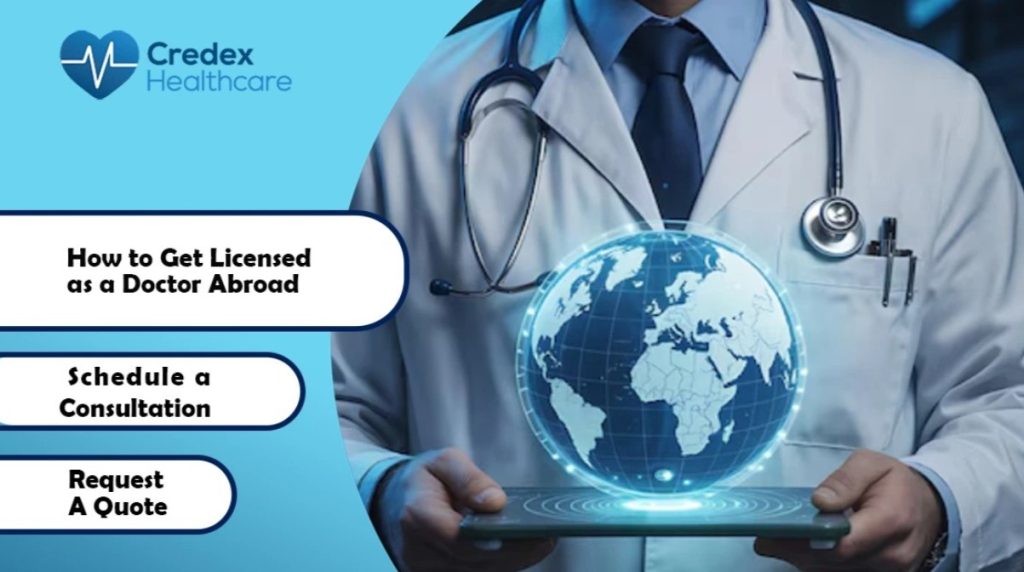
One of the most important choices a doctor can make is whether to practice medicine in a country other than the one where they were trained. However, getting a license to do so is not always easy. Each country has its own set of rules for medical licensing, specific tests that doctors must take, and rules for accepting credentials from other countries. What moves from one state to another and what doesn’t change more than most doctors think before they start.
To get a doctor’s license in another country, you will have to carefully navigate those differences. There is a clear pattern to the steps: qualification review, test, paperwork, application, and acceptance. However, the details at each stage vary enough between countries that a process that worked in one won’t work perfectly in another. This guide talks about the main steps, the tests, the standards for each target country, and the steps that determine whether the process takes six months or two years.
What Does It Mean to Get Licensed as a Doctor Abroad?
Getting a medical license abroad means getting official permission from a foreign country’s medical regulatory body to practice medicine there. It is required by law in every country with a controlled healthcare system, regardless of the qualifications you have in your home country.
Having a medical degree and a legal license from one country does not mean you can practice medicine in another. There are some private deals and mutual recognition arrangements between certain countries, but they are only useful in a few scenarios.
If you want to become a doctor and work abroad, you have to go through the same process whether you are moving there forever, looking for a short-term academic or charity job, using technology to treat patients in another country, or joining a foreign healthcare organization.
Why Doctors Seek Licensure Abroad
Getting a medical license abroad means obtaining legal permission from that country’s medical regulatory body to practice medicine there. It is the rule in every country with a regulated health care system, and it doesn’t matter what credentials you already have from your home country.
You can’t work as a doctor in another country just because you have a medical degree and a license from the first country. Most doctors who want to work in another country must undergo a formal review of their qualifications, pass the tests required by that country, and fill out that country’s full licensing application.
General Requirements for Getting Licensed as a Doctor Abroad
Even though each country has its own rules, the basic needs are always the same, so you can use them as a guide before you get into the specifics of each location.
- To work as a doctor, you need a degree from an approved school.
- A lot of countries verify medical schools against the World Directory of Medical Schools. Degrees not on the list are not usually accepted.
- In high-income countries, you need to have postgraduate training, usually an internship, before you can get your own license.
- In some countries, doctors who are still in training can apply for restricted or controlled licenses.
- Competence in English is required in English-speaking countries. This can be shown by IELTS, OET, or tests specific to the country.
- Applicants must show that they have a clean criminal and professional record and explain any prior sanctions or regulatory actions, if any.
- In most places, you need to have current liability or indemnification insurance before you can get a license.
Step-by-Step Process for Getting Licensed as a Doctor Abroad
Step 1: Research the destination country’s specific requirements
This is the first step because it tells you what tests you need to take, which method of verifying your credentials works best for your degree, and what paperwork the licensing authority needs. Things change, so information from three years ago might not be useful anymore.
Step 2: Get your qualifications assessed
Before an application for a license can proceed, most countries where the doctor is going need to officially evaluate foreign medical degrees. What we call this in the U.S. is ECFMG certification. In the UK, the GMC checks whether your primary medical education is sufficient. The AMC in Australia looks at degrees from other countries.
Step 3: Take the required examinations
Every major destination country requires its own license or ability tests that you have to pass. There are set exam times, and only a limited number of slots are available. Preparation usually takes between six and eighteen months, based on the doctor’s experience and how difficult the test is.
Step 4: Compile documentation
Medical degree and papers, proof of advanced training, licenses in good standing from every country you’ve lived in, proof of name, language test results, and a background check clearing. Most of these must come from the granting authorities instead of the application, which means that no matter how organized you are, it will take weeks to collect them.
Step 5: Submit the licensing application
Fill out the board application for the target country with correct and uniform information across all areas. Inconsistencies between the application and later-confirmed records are the main reason boards ask questions that make the process take much longer.
Step 6: Primary-source verification
The governing body checks your documents directly with the organizations that issued them. This stage usually takes longer than planned because third parties set their own response times.
Step 7: Board review and approval
The complete application is reviewed. Requests for more information at this stage need to be answered quickly. After final approval, a license is issued with an expiry date, and the need to update it starts right away.
Key Destination Countries and Their Licensing Requirements
United States: Medical grads from outside the US must pass USMLE Steps 1 and 2 CK to get ECFMG certification. They must then finish a residency program in the US before they can apply for a state license. For full independence, you need to pass USMLE Step 3, which is usually done during residency. Each state medical board issues licenses on its own, and the time it takes to process them ranges from 4 weeks to 6 months.
United Kingdom: To become a doctor in the UK, foreign medical graduates must pass the PLAB route, which includes both a written test and a practical exam. Alternatively, doctors with recognized expertise from recognized countries can use the portfolio method. The GMC license is national, so it covers all four UK countries.
Australia: To become fully registered, you must complete an Australian-approved practice time. The Australian Medical Council oversees two tests, the AMC CAT MCQ Examination and the AMC Clinical Examination, and looks at medical degrees from other countries. If you pass both, AHPRA will give you temporary registration. A shortened route is open to doctors from countries on the AMC’s list of qualified authorities.
Canada: The MCCQE Parts 1 and 2 exams are administered by the Medical Council of Canada. The licenses are given out by provincial schools, not a national body, and there is some cooperation between regions. For most state licensing paths, international grads must also finish a Canadian visa. This is done through the CaRMS process, which matches people.
Gulf States (UAE, Saudi Arabia, Qatar): Each Gulf state has its own licensing authorities. The Sheryan system is used by the UAE’s Department of Health to handle applications, and the Salama system is used by the Dubai Health Authority. Most Gulf license forms need to check your credentials through Dataflow. The exams you need to take depend on your field and the licensing body.
Common Challenges and How to Overcome Them
Timelines for studying for tests are the features that are most often overlooked. The USMLE Step 1 and Step 2 CK exams, the PLAB 1 and 2 exams, and the AMC exams all need a lot of concentrated study time. When doctors start the licensing process, they often think they can take exams within a few months of the decision. However, the process often takes longer than expected due to the time it takes to prepare for and schedule exams.
Credential company acceptance gaps occur when doctors come from schools or countries whose credentials aren’t immediately recognized by the local authority. In these situations, more guided practice, bridge programs, or extra tests may be needed before the full license can be issued. Doing research on this before moving instead of after keeps doctors from arriving in a new country only to find that the process of getting licensed takes much longer than they thought.
Demands for English language skills catch some doctors off guard. The Occupational English Test (OET) is now accepted along with IELTS in several countries, such as the UK and Australia. It tests English in a clinical setting instead of an academic one. People don’t always plan ahead enough to make sure they take the appropriate language test for the place they want to go to and have time to study for it.
Tips for Getting Licensed as a Doctor Abroad Successfully
Start evaluating qualifications and signing up for exams before you do anything else. Once they start, you can’t change when they need to be completed, and both need to be completed before the licensing application can move forward. For most target countries, starting them 12 to 18 months before you plan to start practicing is not too early.
Get in touch with doctors in the country of your choice who have recently finished the same path. The licensing process changes over time, and new information from personal experience fills in the blanks that government guidelines don’t always cover. International physician networks and state medical groups are good places to start.
If you are going to more than one country, have a complicated work history, or are working with a tight deadline, you should use a professional foreign medical registration service. The amount of planning that goes into qualification assessment, test schedule, document collection, and board application handling is more than most doctors can handle while also preparing for exams or doing their clinical work.
Frequently Asked Questions
How long does it take to get licensed as a doctor abroad?
For most target countries, the true range is between one and three years from the point of choice. This includes evaluating qualifications, preparing for and taking exams, gathering documents, and board processing. Doctors with basic credentials who apply to places with faster working hours can sometimes finish in less than a year. Situations that are hard to understand can last longer.
Which examinations are required to practice abroad?
These are USMLE Steps 1, 2, and 3 for the US. PLAB 1 and 2 for the UK. You can get AMC CAT MCQ and AMC Clinical in Australia. These are Canada’s MCCQE Parts 1 and 2. Gulf states have different levels of requirements for different specialties. The exact exam path relies on the applicant’s training history and the place they want to go.
Can I practice as a doctor abroad without getting licensed?
No. Practicing medicine without a valid license in the relevant jurisdiction carries criminal penalties and civil liability in every regulated healthcare system. Temporary registration or supervised practice arrangements exist in some countries for physicians in bridging programs, but these are formal arrangements with specific conditions, not alternatives to licensure.
Do I need to redo my residency to practice abroad?
Not at all. In every controlled healthcare system, practicing medicine without a valid license is illegal and can lead to civil and criminal liability. In some countries, doctors in bridge programs can get temporary registration or supervised practice. However, these are official setups with strict rules that are not options to get a license.
What is the hardest part of getting licensed as a doctor abroad?
Usually, the schedule includes both studying for the test and verifying credentials. Both take longer than most doctors expect at first, and they both need to be finished before the license paperwork can be sent in. The best thing a doctor can do to keep the process from taking too long is to plan the examination and application preparation timing fairly from the start.
Conclusion
To get a doctor’s license in another country, you need to do a lot of research and not make assumptions about how skills work in other countries. The route can be negotiated by most doctors if they have accurate knowledge about the requirements of the target country, realistic timelines for exams and certificate verification, and consistently meet all paperwork and application requirements.
Support for professional licenses makes a real difference for doctors who must deal with complex foreign routes, multiple target countries, or tight deadlines. The process has too many effects and changes too often to be managed using outdated data or broad assumptions.
Elevate Your Healthcare Practice Today
Contact Credex Healthcare’s medical licensure services today