Skip to content


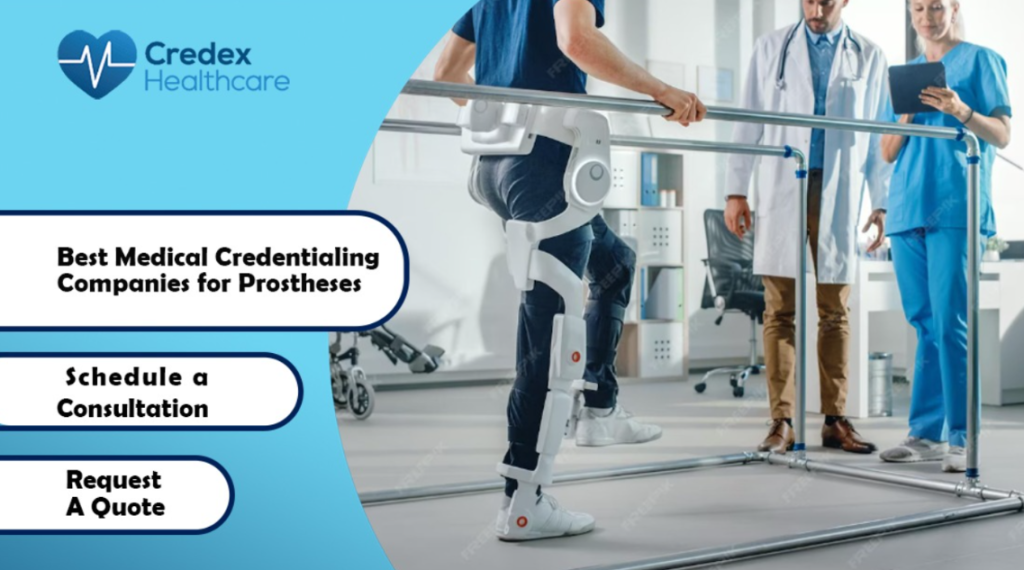
The prosthetics and orthotics healthcare professionals help patients who have lost limbs for various reasons. These patients need mobility devices immediately to get most of their movement back. But it is challenging for prosthetic providers to provide the required services if they are not credentialed. Even though they have the right staff and equipment, they cannot charge Medicare DMEPOS or insurance networks for their work without the right credentials.
Prostheses credentialing mixes rules for permanent medical equipment with standards for medical devices, making the process difficult to understand. It includes signing up entire facilities to get DMEPOS approval, following strict CMS supplier rules, getting surety bonds, and dealing with different state licensing laws. One mistake in the paperwork can delay patients’ access to important prosthetics for months. The best medical credentialing companies for prosthetics are skilled at getting around these problems. They are also excellent at Medicare DMEPOS enrollment, licensing based on the state, NPI registration for prosthetists, and keeping up with CMS rules as they change.
What is Prostheses Credentialing?
Your hospital can submit bills to Medicare, Medicaid, and commercial payers for its prosthetic products after the verification and enrollment processes. Prosthetic credentialing involves facility qualifications, supplier qualifications, and product authorizations.
Prosthetists and orthotists need to provide their NPI, verify their O&P education, and provide certification from either the American Board for Certification in Orthotics, Prosthetics & Pedorthics (ABC) or The Board of Certification/Accreditation (BOC). The O&P provider needs Medicare DMEPOS certification because it is crucial and necessary to meet the quality standards required by Medicare DMEPOS.
Medicaid requirements vary across states, with some requiring a six-month accreditation of recipients. Most third-party carriers, such as Aetna and Cigna, have comprehensive panels or limit applications. Registration through CAQH is often utilized for maintenance of prosthetist credentials for easier application processing but not for accounting for individual carrier requirements.
Why Credentialing is Essential for Prosthetic Providers
Prosthetic clinics need to have the right credentials to work well in today’s healthcare system, which is based on insurance. Because a lot of patients rely on Medicare and Medicaid, delays in credentialing can hurt clinics’ finances and reputation, among other things:
- Medicare and Medicaid pay for 60 to 80 percent of prosthetic patients.
- Not enrolling in DMEPOS can mean missing out on patients.
- The cost of custom prosthetic devices can be anywhere from $5,000 to $50,000.
- Delays can slow down billing for months, which can hurt cash flow.
- There are now a lot more rules that prosthetic providers must follow.
- CMS does thorough audits and site visits for DMEPOS suppliers.
- Delays in credentialing can hurt a professional’s reputation and the trust of patients.
- Patients might go to competitors for care because they must wait so long.
Key Credentialing Challenges in Prosthetic & DME Services
DMEPOS Accreditation Requirements—Before enrolling in Medicare, your prosthetic facility must be CMS-accredited. This requires thorough documentation, personnel certification verification, and detailed on-site assessments of every operation.
State Licensing Variations—Many states need prosthetic and orthotic facility licensure beyond company registration. Multi-state prosthesis credentialing firms must follow renewal dates and changing rules since state requirements vary greatly.
Surety Bond Requirements—Medicare requires DMEPOS vendors to deposit a $50,000 surety bond per practice. These bonds need yearly renewals to avoid Medicare billing privilege revocations and credit checks and financial evaluations that delay credentialing.
Ongoing Compliance Obligations—DMEPOS certification continues after enrollment. CMS demands 3-5-year revalidation, commercial payers 2-3-year recredentialing, and DMEPOS certification every three years with extensive surveys.
How to Choose the Best Prostheses Credentialing Company
Choose credentialed partners with DMEPOS expertise. Ask about Medicare DMEPOS enrollment and prosthetic clinic credentialing history. Prosthetic credentialing companies know DMEPOS Quality Standards, accreditation, and L-code billing.
Prefer complete facility credentialing, not simply provider enrollment. Prosthetic clinics require partners for DMEPOS accreditation, surety bonding, and multi-state facility licensure. Due to regulatory monitoring, evaluate their compliance support. Your partner should keep CMS surveyors, state licensing bodies, and payer auditors satisfied with audit-ready documents.
Top Medical Credentialing Companies for Prostheses
Following are the best medical credentialing companies for prostheses in the US:
Credex Healthcare

Credex Healthcare is a leading prosthetic credentialing service due to their extensive experience serving specialty practices requiring both individual provider credentialing and complex facility enrollment. Credex has extensive experience certifying durable medical equipment suppliers, prosthetic clinics, and orthotic providers, who confront the unique constraints of facility-based credentialing and individual prosthetist enrollment.
Their thorough facility certification distinguishes Credex for prosthetic providers. They handle prosthetist enrollments, facility DMEPOS applications, Medicare enrollment preparation, accreditation coordination, surety bond assistance, and state licensing across several jurisdictions. Their staff knows the DMEPOS Quality Standards that prosthetic facilities must meet. They will also help you get ready for the accreditation exams that affect Medicare billing.
Credex designates credentialing experts to each prosthetic client to ensure that someone who knows your services and locations monitors all your applications. When you are making custom prosthetic limbs with advanced componentry and microprocessor knees, having one credentialing specialist who understands your entire operation prevents errors caused by multiple people working on your files without understanding prosthetic billing.
They handle Medicare DMEPOS enrollment via PECOS, state Medicaid enrollment in various states, and commercial payer credentialing with Aetna, Cigna, UnitedHealthcare, and Blue Cross Blue Shield. Credex helps prosthetic facilities maintain ongoing enrollment without interruptions that might affect patient care and income by creating and maintaining CAQH profiles for prosthetists, recredentialing management, and compliance assistance.
Prostheses / DME Credentialing Expertise:
Complete DMEPOS facility enrollment, individual prosthetist credentialing, accreditation preparation, multi-state licensing
Key Services Offered:
Medicare DMEPOS enrollment, Medicaid enrollment, commercial payer credentialing, CAQH management, surety bond assistance, recredentialing
Compliance & CMS Experience:
Extensive DMEPOS Quality Standards expertise, accreditation survey preparation, ongoing compliance monitoring
Best-Fit Clients:
Prosthetic clinics of all sizes, multi-location O&P providers, facilities expanding to new states
MedCare MSO
MedCare MSO has focused on licensing and enrollment for healthcare workers across the country. They have a 95% overall success rate, with Medicare DMEPOS registration being their strongest area. They keep an eye on credentials proactively, which means they track when DMEPOS accreditations, safety bonds, and state licenses expire and when recredentialing dates pass. They know how to give credentials to prosthetic facilities that offer many kinds of services, such as prosthetic limbs, orthotic braces, and custom wheelchairs, because they have worked in complex specialty offices for years.
Global Tech Billing LLC

Global Tech Billing LLC is an expert at DME credentialing services, especially when it comes to working with prosthetics and orthotics companies. They have a deep understanding of the strict rules that DMEPOS providers must follow. They take care of the whole Medicare DMEPOS registration process, from filling out the application to final acceptance. They also do compliance reviews to catch mistakes before they get to CMS. Their clear pricing and payment-after-approval plan lowers the revenue doctors get for prosthetics procedures.
Practolytics
Practolytics serves many active providers across 28+ specialties with technology-driven credentialing combining automation with human expertise. They have made special processes for DMEPOS providers, such as centers that work with orthotics and prosthetics. This makes sure that the places get the right credentials, considering approval and source standards. Their active follow-up and progress tracking keep Medicare contractors and funders in touch with them, so applications do not just sit there. They also handle prior authorizations for costly prosthetic parts and payment help that works with licensing.
Transcure
Transcure serves providers with maximum customer retention through qualified team who understand DMEPOS credentialing for prosthetic providers. They serve various providers and have great number of retained customers. They do both DMEPOS credentialing and revenue cycle management, which is useful because the two tasks are closely connected. They efficiently handle Medicare and Medicaid revalidations, oversee CAQH accounts for individual prosthetists, and make sure that prosthesis center managers can reach them at any time.
Verisys
Verisys is a trusted credentialing company with years of experience. Their enterprise-level knowledge is useful for big prosthetic sites and O&P companies with more than one location. They get over 99.95% accuracy in checking source data and keep NCQA, URAC, and other important licensing certifications. Automated checks and continuing management of each substitute provider’s credentials for all payers prevent credentialing gaps that could potentially result to the denial of claims.
CureMD
CureMD has been praised for greatly accelerating the licensing process. For example, it used to take months to join in DMEPOS, but now it only takes them a few weeks. Medicare DMEPOS enrollment, Medicaid enrollment, commercial payer credentialing, NPI registration, and CAQH profile management are all parts of their personalized service. They provide useful help with managing licenses and certifications. This makes sure that prosthetists’ ABC or BOC certifications are up to date. Their active application management always keeps Medicare DMEPOS contractors and customers in touch with each other and follows up ahead of time to cut down on delays.
National Credentialing Solutions (nCred)
With their own tool for real-time application tracking, nCred lets prosthetic providers stop having to call all the time to check DMEPOS registration progress. They work with everyone from solo prosthetists to big, multi-location businesses, using technology and skilled staff who know how to process DMEPOS credentialing. Because they work nationally, they know how the process for Medicaid registration and state replacement licensing differs from one state to another.
Knack RCM
Knack RCM offers complete revenue cycle management and certification services that are tailored to healthcare providers like DMEPOS sellers and prosthesis centers. They handle Medicare DMEPOS registration, commercial payer credentialing, and state Medicaid forms as part of their full credentialing service. Their team knows the special rules that prosthetic facilities must follow. They handle full facility credentialing and billing services, which creates a unified approach that stops the gap between credentialing and billing.
Ace Med Assist
With a decade of experience working with healthcare workers in over 30 fields, Ace Med Assist has become known as a trustworthy partner for medical bills and licensing. For urgent situations, they often get enrollments with Medicare, Medicaid, and private payers within 10 days. This is because they offer sure credentialing services. Their team helps all the time during the credentialing process by working together with prosthetic centers to understand their particular needs and provide custom DMEPOS registration solutions.
Credentialing & Enrollment Services for Prosthetic Clinics
When you apply for Medicare and go through PECOS, professional credentialing companies take care of complete DMEPOS center registration. They get all the papers they need, such as your facility’s Tax ID, NPI, proof of ownership, practice location, safety bond papers, liability insurance certificates, and licensing papers.
If you run a replacement facility that helps people in more than one state, you have to fill out more than one Medicaid application. Each state has its own forms and rules. Professional credentialing companies can quickly and clearly understand and manage the different standards for each state and multiple enrollments at the same time.
If commercial payers want to be approved, they must fill out forms for big insurance companies. Most businesses use CAQH to find information about individual prosthetists. To get your facility certified, though, they need to see more documents showing your DMEPOS approval, your Medicare registration, and your specialty. Getting ready for DMEPOS approval is an important step for companies to make sure that credentialing groups can see their rules, steps, and forms during surveys.
Medicare, Medicaid & Private Payer Requirements
According to 42 CFR §424.57(c), Medicare DMEPOS needs replacement suppliers to meet certain range of standards. Your facility needs to keep a place where patients can go, hire licensed prosthetists, accept assignment on all Medicare claims, get complete liability insurance, and post security bonds. Medicare needs a $50,000 security bond for every place you have the right to bill them.
Each state’s Medicaid program has its own rules about how prosthetic providers can work there. Some states use simpler methods that are like how people apply for Medicare, but other states keep their systems separate and have different ways of filling out the paperwork. Some states do not allow new prosthetic facilities to join their closed panels, and Medicaid payment rates for prosthetic devices vary greatly from state to state.
Meanwhile, insurance companies have very different rules for commercial payers. Some companies have restrictive DME panels, but others have open ones that welcome new replacement providers. Before granting business licensing, a lot of commercial insurance companies want to see that replacement sites are signed up for Medicare. Payer contracts tell you how to go about prior permission, paperwork standards, complaint processes, and payment methods.
FAQs About Prostheses Credentialing
How long does prostheses credentialing take?
It usually takes between 120 and 180 days to get a prosthetic center fully credentialed for Medicare DMEPOS, state Medicaid, and private insurance. However, this can change based on the state regulations and how quickly the payers respond.
What is DMEPOS enrollment for prosthetic providers?
If a facility wants to provide Medicare recipients with permanent medical equipment, prosthetics, braces, supplies, or all of these, they must go through the DMEPOS registration process. It needs approval from the facility, safety bonds, and compliance with the strict CMS provider standards.
Do prosthetists need CAQH registration?
Yes, individual prosthetists should keep their CAQH profiles up to date because most commercial insurance companies use CAQH to get provider information while they authorize facilities. However, CAQH itself does not complete prosthesis facility registration.
Is Medicare enrollment mandatory for prosthetic clinics?
Even though it is not officially required, enrolling in Medicare is basically necessary because 60% to 80% of prosthesis users are Medicare patients. If you do not have Medicare enrollment, you cannot serve the patients who have Medicare insurance which could make your revenue suffer.
How much does prostheses credentialing cost?
Initial credentialing with Medicare, Medicaid and commercial payers usually costs between $8,000 and $20,000. It costs $300 to $600 every month to monitor and recredential. The final cost, however, depends on how big and how many facilities there are.
Conclusion
People who lose a leg due to an accident, illness, or a condition they were born with are some of the people prosthetic companies help. With your professional knowledge and the help of modern replacement technology, you can change people’s lives by giving them back their mobility and freedom. Do not let the time it takes to get your credentials keep you from helping people who really need your services.
The credentialing companies listed here have specific DMEPOS knowledge, experience with facility credentialing, and an understanding of the difficult rules prosthesis providers must follow every day. They can help your clinic with Medicare DMEPOS registration, state licensing, commercial payer credentialing, and ongoing compliance management. This can all be done quickly so that patients do not have to wait and your revenue does not get delayed.
Professional credentialing services give you the knowledge you need to avoid expensive errors and start helping patients more quickly, whether you are a solo prosthetist opening your first clinic, a company with multiple locations that wants to expand to new states, or an established O&P facility that is adding new services. Pick a credentialing partner that knows how hard it can be to work with prosthetics and can easily adhere to DMEPOS standards. The replacement care you give your patients is important. Do not let the difficult process of getting credentials keep them from getting back to independent movement.