Skip to content



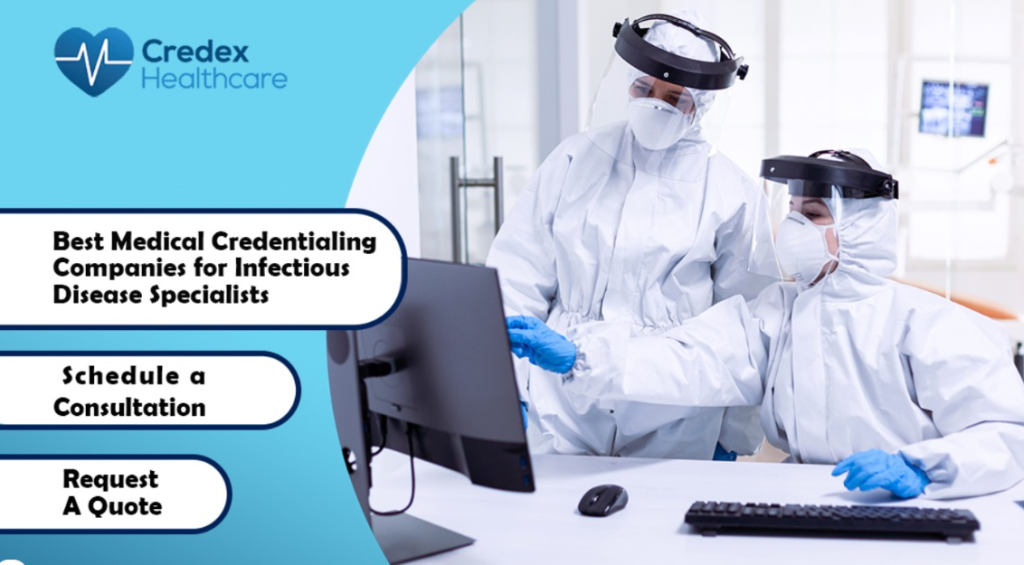
Infectious disease specialists are the first line of defense in healthcare. They diagnose and treat all sorts of issues, from common bacterial infections to new diseases that spread quickly and threaten everyone. You save lives with your knowledge, but if you are not properly credentialed, you cannot serve the patients in insurance networks or get paid for your work. Getting credentials for experts in viral diseases is challenging because it has its unique requirements and specialty-focused knowledge.
Infectious disease practices, whether they are in a hospital, a private setting, or a multi-specialty practice, can experience either quick payer registration that allows patients to be seen right away or delays of several months that threaten the practice’s survival. Selecting the appropriate credentialing partner makes a significant difference.
This blog outlines the best medical credentialing companies for infectious disease specialists to help you choose the right partner to get fast credentialing.
What Is Infectious Disease Credentialing?
Infectious disease (ID) credentialing is a comprehensive process that validates an ID doctor’s qualifications, enabling participation in insurance networks, hospital privileges, and patient billing. It verifies their medical school graduation, completion of an internal medicine internship, and specialization in infectious diseases, along with board credentialing, state medical licenses, DEA registration, and liability insurance.
ID specialists must fulfill additional requirements, such as demonstration of fellowship training in tropical medicine, antibiotic management, transplant infectious disease, and HIV medicine. Verification of specialist credentials, like as HIV knowledge and drug management training programs, is another thing that insurance companies look for.
Creating a CAQH profile that includes information about one’s employment history is usually the first step in the credentialing process. Individual applications to hospitals and insurance companies such as Medicare, Medicaid, Aetna, Cigna, Blue Cross Blue Shield, and UnitedHealthcare are then required. For ID specialists connected to several hospitals, this procedure is more complicated because each hospital requires its own committee evaluations and privileging applications.
Why Credentialing Is Crucial for Infectious Disease Physicians
Credentialing for infectious disease physicians is important. Proper credentialing is the fundamental requirement to optimize practice growth and revenues.
Hospital Privileges
Infectious disease practice is primarily designated in hospitals, requiring privileges for inpatient consultations and management. Credentialing committees assess fellowship training, case logs, peer references, and malpractice histories, with the process taking 90–120 days and necessitating thorough documentation.
Insurance Reimbursements
ID physicians rely heavily on insurance reimbursements for revenue. Successful payment for outpatient consultations and inpatient care hinges on the completion of payer credentialing; without it, claims are often denied. Typically, ID practices must enroll with 10-15 insurance companies, each requiring separate applications.
High-Risk Patient Populations
ID specialists often treat complex, high-risk patients, such as those with HIV/AIDS or cancer. Insurance companies closely examine claims for these patients due to the high costs of medication. Credentialing must reflect expertise in managing this large number of patients through proper training and credentialing; incomplete credentialing can result in claim denials, even for urgent care.
Best Medical Credentialing Companies for Infectious Disease
Following are the leading companies for medical credentialing companies for infectious disease:
Credex Healthcare

Credex Healthcare has established itself as a leading credentialing partner for specialty physicians across the United States. Their infectious disease credentialing specialists meet complicated hospital and payer enrollment standards. Credex provides credentialing services nationwide and employs specialized specialists who understand the particular credentialing problems that infectious disease physicians confront.
Company Overview:
Credex Healthcare provides comprehensive medical credentialing services focusing on specialty practices requiring both hospital privileging and insurance payer enrollment. Their personalized service model assigns dedicated credentialing specialists to each physician client, ensuring consistent management of all applications.
Infectious Disease Expertise
Credex understands that infectious disease credentialing requires documentation beyond internal medicine standards. Their specialists know how to verify fellowship training in infectious disease. Their credentialing team is expert in subspecialty credentialing like HIV specialist hepatitis C treatment, and antimicrobial stewardship. They effectively present complex ID training to hospital credentialing committees and insurance reviewers.
Services Provided:
Hospital privileging for ID specialists, Medicare and Medicaid enrollment, commercial payer credentialing (all major insurance companies), CAQH profile creation and management, ongoing recredentialing every 2-3 years, license and credentialing monitoring, DEA registration support, and compliance documentation for specialty infectious disease services.
Why Chose Credex Healthcare:
Credex’s dedicated specialist model proves invaluable for ID physicians managing complex multi-hospital practices. Your assigned credentialing specialist knows your specific infectious disease training, subspecialty areas (HIV, transplant ID, antimicrobial stewardship), and practice locations. This expertise prevents errors that occur when multiple people handle your files without understanding infectious disease practice comprehensively. Their experience with specialty physicians means they immediately understand ID-specific requirements without needing additional training.
Z MED
With more than eight years of experience working with healthcare offices across the country, Z MED Solutions stands out as a full medical billing and credentialing business. Their credentialing services handle the tricky parts of registration so that doctors can focus on treating patients, and experts in infectious diseases do not have to worry about paperwork.
Z MED helps with all aspects of credentialing. They do insurance panel registration, setup and upkeep of CAQH profiles, credentialing for Medicare and Medicaid, and ongoing checks of credential validity. Z MED knows how to deal with the unique rules of different specialties. Their organized method makes sure that all forms are filled out correctly and that all paperwork is turned in on time, so there are no delays.
Transcure
Transcure has been helping healthcare workers in 32 specialties with complete revenue cycle management and credentialing services. Transcure has an extensive knowledge about healthcare and knows how to bill for and credit infectious diseases. They do this with over 1,100 qualified billers and coders.
Transcure provides credentialing services along with medical billing support to experts in infectious diseases. They handle Medicare and Medicaid revalidations proactively, run CAQH accounts, and provide 24/7 help for ID doctors working irregular hospital schedules.
CureMD
CureMD is known for quick turnaround time in obtaining credentialing for all specialists, including infectious diseases. Their personalized credentialing service takes care of business insurance, government programs, NPI registration, and CAQH profile management.
Their active application management keeps the insurance companies and hospital credentialing professionals in the loop during the whole process and follows up right away. CureMD has credentialing requirement information for many settings, such as hospital-based infectious disease practice.
Physician Revenue Group

The Physician Revenue Group has more than twenty years of experience in medical billing and credentialing and knows a lot about helping healthcare professionals in revenue optimization. Physician Revenue Group provides full credentialing services that help ID offices connect with insurance payers.
They handle the paperwork, keep doctors’ credentialing up to date, and save infectious disease physicians a lot of time that can be used to treat patients. They offer credentialing services to both large and small infectious disease practices, including contract negotiation.
AltuMED

AltuMED offers high-end credentialing services that help with the management of the healthcare system, including the operations of infectious disease practices. Their broad range of services helps experts in viral diseases go from focusing on paperwork to focusing on clinical excellence.
AltuMED does the whole credentialing process, from gathering documents to getting insurance approval. They also do compliance checks, quality assurance, and keep provider verification up to date. All their infectious disease fellowship training, specialist credentialings, and specialty qualifications are properly recorded and confirmed through their structured verification system.
Med Xpert Services

Med Xpert Services provides full credentialing services that smoothly join experts in infectious diseases with payers and optimize their revenue. Their team of experts makes sure that ID offices can smoothly join insurance networks and optimize revenue cycle management.
Med Xpert handles the full registration of payers, including the credentialing of Medicare, Medicaid, and private insurance. Med Xpert gives infectious disease experts the help they need with things like hospital privileging, specialty credentialing, and infectious disease billing.
iRCM Inc
iRCM Inc is based in Brooklyn, New York, and offers complete medical billing, coding, and credentialing services to healthcare workers across the country. The company’s specialty is improving medical practices’ financial health and simplifying income workflows.
iRCM’s full credentialing and registration services cover private insurance credentialing, Medicaid enrollment and re-enrollment, CAQH and PECOS gateway handling, and compliance guidance in every state. iRCM accelerates the credentialing process for infectious disease experts, follows up with payers quickly, and communicates proactively with them during the process. Their team actively manages applications from the time the application is turned in until they are approved.
Sybrid MD
Sybrid MD (MD Syhealth LLC) provides all kinds of healthcare solutions to more than 100 medical practices in 22 states. It has expertise in revenue cycle management and full credentialing services. It helps doctors get their credentials and apply for recredentialing.
They ensure adherence to NCQA and DHFS guidelines. Their range of services includes creating and updating the CAQH and PECOS websites, fixing staffing problems, and making sure that data is correct by doing regular checks. Sybrid MD provides infectious disease specialists with customized services based on the exact needs of their practice.
Verisys

Verisys is a trusted credentialing company and provides credentialing to many providers every year. Their knowledge of the field is great for hospital systems that hire multiple experts in contagious diseases. They have a higher accuracy rate in primary source verification. Their NCQA and URAC credentialing ensures qualifications meet the top standards in the field.
With automated verification methods, Verisys keeps licenses, IDs, and penalties up to date for all hospitals and providers. For teaching hospitals and health systems that deal with infectious diseases, Verisys offers scalable solutions to fit the needs of each client.
Step-by-Step Credentialing Process for Infectious Disease Doctors
Step 1: Documentation Gathering
Collect all the documents, including the diploma from medical school, the certificate of completion of residency in internal medicine and a fellowship in infectious disease, board credentialing in both internal medicine and infectious disease, and state medical licenses. Also, have your DEA certificate, professional liability insurance, a CV, peer references from ID doctors, and proof of hospital privileges from current facilities prepared.
Step 2: CAQH Profile Creation
Accomplish your CAQH profile that includes your entire work history. Include in the profile all your infectious disease school information, specialist licenses, hospital connections, and practice sites. This description is the basis for most applications for insurance payers.
Step 3: Hospital Privileging Applications
Turn in hospital privilege applications for all the places you will work. Add detailed records of your infectious disease fellowship and cases that show you are eligible for ID consultations and procedures. Provide references from other infectious disease experts and seek permission to consult with inpatients and manage ICU patients with infectious diseases.
Step 4: Medicare Enrollment
Through PECOS, you should complete Medicare registration and record all office sites, tax identification details, and the infectious disease services you provide. It usually takes 60 to 90 days to sign up for Medicare.
Step 5: Medicaid and Commercial Payer Applications
Submit a separate application to each commercial insurance (Aetna, Cigna, UnitedHealthcare, Blue Cross Blue Shield, etc.) and to your state Medicaid program. Most payers will look at your CAQH profile, but you will still need to fill out forms that are specific to your payers.
Step 6: Follow-Up and Approval
Maintain regular follow-ups with all payers and hospitals, answering questions quickly and sending extra paperwork when asked. Professional credentialing companies establish their follow-up protocol to prevent delays due to missed notifications.
Common Credentialing Mistakes to Avoid
- Hospitals and payers frequently wait because documentation for fellowship training for infectious disease specialists is missing.
- The internship certification should contain important information such as the dates of the rotations, the names of the supervising physicians, and the fields of training (for example, HIV, donor ID, antibiotic management, and tropical medicine).
- When information is different across CAQH, PECOS, and billing forms, it might be challenging to verify. It is very important that all documents are consistent.
- Many physicians who treat infectious diseases do not realize how long it takes to obtain a hospital license and think that delays are mostly caused by signing up for insurance.
- Delays in hospital credentialing are worse when committees do not meet often; it is essential that hospitals submit their applications on time.
- Experts need to prove their subspecialty expertise to receive authorization to undertake specialized treatments; they need to keep extensive records of their training and experience.
Conclusion
Infectious disease experts provide critical care that communities rely on, but the frustration of procedural credentialing should not stop you from serving patients who need your expertise. The credentialing companies described in this guide have a lot of experience and specialty knowledge, and they also use efficient processes that help ID doctors get certified more quickly while keeping the accuracy and compliance that infectious disease practice needs.
At Credex Healthcare, we know that specialists in infectious diseases face problems with credentialing that need special knowledge and full attention. They have dealt with complicated hospital privilege needs and gotten insurance approvals that let infectious disease experts start working right away. Get in touch with us to learn how our specialized credentialing services for infectious diseases can help you get registered and start practicing more quickly while strictly following all rules.
FAQs
How long does infectious disease credentialing take?
It usually takes 120 to 180 days to complete all the credentials, such as getting permission to work at a hospital and signing up for insurance. However, just getting hospital credentials can take 90 to 120 days.
Do infectious disease doctors need separate hospital credentialing?
Yes, each hospital needs its own privileging forms, approval from the credentialing committee, and clear standards of infectious disease privileges for the sessions and treatments specialists will carry out.
What documents are required for credentialing?
Medical school diploma, residency certificate for internal medicine, training certificate for infectious disease, board credentialing for internal medicine and ID, state medical licenses, DEA certificate, liability insurance, CV, and peer references.
Can credentialing companies handle revalidation?
Yes, experienced credentialing companies handle the entire revalidation process. This includes revalidating with Medicare every five years and recredentialing payers every two to three years. Credentialing companies also keep track of end dates and start the renewing process ahead of time.
How often does credentialing need to be renewed?
Insurance companies need to renew their credentials every two to three years to make sure they are still valid. Medicare needs to be revalidated every five years. Based on what each state requires, physician licenses must be renewed every one to two years.