Skip to content




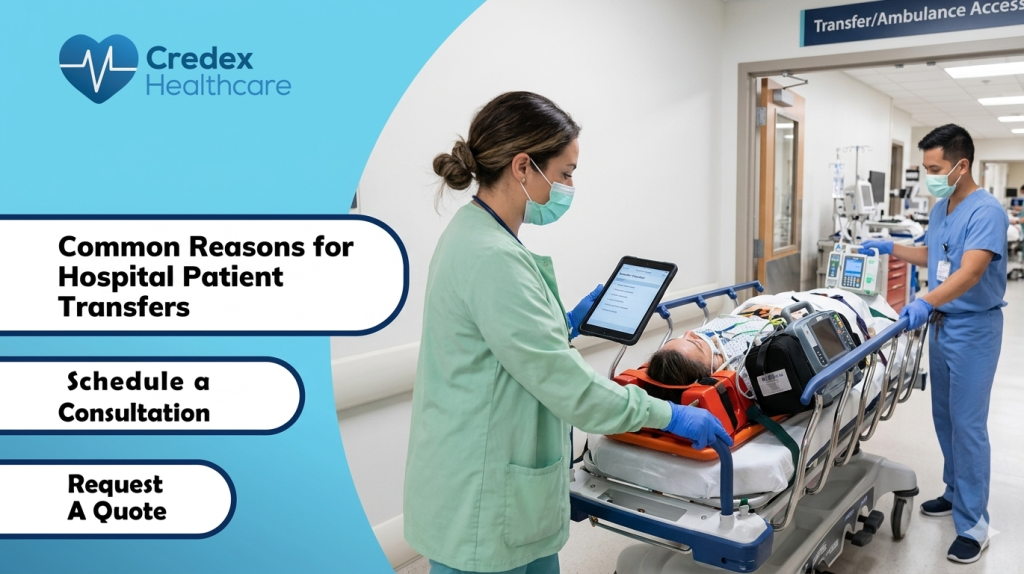
Hospital patient transfers, also referred to as ‘interhospital transfers,’ are processes involving the safe transfer of patients from one healthcare facility to another for treatments or related services that cannot be provided by the healthcare provider in the first hospital.
Transfers help to provide the safest possible environment for the patient; maintain continuity of medical treatment; and assist in compliance with federal regulations by the Centers for Medicare & Medicaid Services (CMS) through the Emergency Medical Treatment and Active Labor Act (EMTALA), requiring that all emergency department patients be stabilized prior to transferring them to other locations. Therefore, healthcare providers, managers, students, and caregivers can deem it beneficial to understand why hospitals transfer patients to improve outcomes and reduce risk complications.
Some of the most common reasons for hospital patient transfers include specialized care requirements, lack of advanced equipment and technology, ICU or bed capacity shortages, insurance or network requirements, physician or specialist availability, and a higher level of trauma or emergency care. This blog will look into the reasons, how the interhospital transfer process works, and the risks pertaining to it.
What is a Hospital Patient Transfer?
A hospital patient transfer is the medical supervision of an individual who will be relocated from one healthcare facility to another, generally because of the patient’s medical condition requiring relocation and specialized treatment that can be provided at a different facility than where the patient is currently located.
Hospital patient transfers are different from intra-hospital moves, the type of transfer that takes place within the same hospital, typically from one unit to another, like moving from a ward to an ICU within the same building.
There are many types of hospital patient transfer:
- Intra-hospital transfers (bed to bed, stretcher to stretcher)
- Interhospital transfers (the movement of patients from one hospital to another).
- Emergency patient transfers
- Non-emergency patient transfers (for patients who are stabilized but require more treatment) that involve an elective follow-up visit for a patient with cancer.
- Critical care transfers (transferring critically ill patients who may require continuous support and monitoring during transport).
Regulatory oversight in terms of patient transfer is provided by CMS and EMTALA (the Emergency Medical Treatment and Active Labor Act), which establish guidelines for screening, stabilizing, and transporting patients. This does not take the financial status of the patient into consideration. Using standardized protocols for patient transfers can help minimize delays or risk of errors.
Need for Specialized Care
A common reason that patients get transferred from primary care hospital settings to tertiary care hospital settings is to receive specialized services such as trauma centers, cardiac surgery, neurosurgery, oncology, or neonatal intensive care units (NICUs), which are typically not available at local or rural care hospital settings.
- Trauma centers: Provide OR access on an urgent basis for gunshot wounds or severe injuries from falls
- Cardiac/Neurosurgery: Not available in many rural areas and includes complex procedures such as valve repairs and aneurysm clipping
- Oncology/NICU: For specialized chemotherapy or ventilation for premature infants
The American College of Surgeons (ACS) has an established criterion that all inter-hospital transfers of patients must follow, as it has been shown to help reduce mortality rate in these complex cases by 25%.
Lack of Equipment or Advanced Technology
Several small community hospitals are at a disadvantage when it comes to having high-technology diagnostic equipment. Equipment like high-field-strength MRI/CT systems, which provide higher detail images than lower field strength machines, cath lab (cardiac catheterization laboratory) systems that have minimally invasive coronary interventions, robotic systems for surgical procedures (robotic surgery), and burn unit facilities with specialized wound care staff.
In such scenarios, patients will be required to be transferred from their local hospital to a larger hospital with the capacity to treat them. This highlights how the hospital transfer process provides patients with access to the necessary technologies to aid in an accurate diagnosis and improve patient recovery times, as well as allowing those larger hospitals to utilize expensive technology to provide quality care to a wider population.
ICU or Bed Capacity Shortages
As the World Health Organization has reported, ICU bed shortages due to hospital overcrowding, influenza season, and pandemic surges cause patient transfers. During the peak of a flu season, for example, most hospitals will have an occupancy rate of over 90%. To accommodate surging demand in the emergency department (ED) and/or the ICU, hospitals often divert low-risk, stable patients to free up beds for critically ill patients who require intensive care.
Hospitals utilize critical care transfer protocols to identify low-risk critically ill patients who can be safely transferred to another hospital when the receiving hospital is at capacity. Dashboards are also used to match ICU beds with potential transfers.
A few incidents where the shortage issues were highlighted:
- Seasonal spikes: Hospital ICUs experience overwhelming numbers of patients requiring mechanical ventilation during the winter months due to an increased number of respiratory cases.
- Pandemic surges: COVID-19 pandemic surges have resulted in similar high demands on ECMO services (mechanical circulatory support).
- Rural limitations: Rural hospitals typically do not have large ICUs and therefore may need to shift their critically ill patients to urban hospitals when they reach maximum capacity.
Insurance or Network Requirements
Healthcare providers are required to refer patients to in-network sites that will provide covered services, as CMS has a policy of paying per diem to senders for referrals; managed care also directs to the most cost-effective or medically appropriate facilities, thereby avoiding out-of-network costs. By managing referrals in this manner, providers can maintain a balance between financial limitations and providing high-quality patient care.
- In-network facilities: The nearest facility to the patient’s home is used when performing a joint replacement procedure.
- Managed care limitations: Payers require prior authorization for all non-emergency referrals.
- Payer-directed transfers: Payers ensure that documentation of medical necessity accompanies all Medicare referrals.
Many rural hospitals do not have their own specialist on call at night and therefore transfer patients for specialty expertise in cardiology and neurology. While the use of telemedicine can help, it can never be a substitute for hands-on treatment when dealing with complex cases. In fact, the use of telemedicine is an example of addressing one of the most common types of staffing shortages that exist in remote areas.
Hospitals in rural areas without many resources face the following challenges:
- A large gap in on-call coverage exists; there are no nighttime neurosurgeons available to cover on-call needs at hospitals in many rural communities.
- While telemedicine can help with basic assessments and provide immediate access to consultations from specialists located elsewhere in the country, it cannot perform any physical interventions.
- There is already a rising shortage of physicians in the U.S., which, according to the Association of American Medical Colleges, can worsen by 2030.
Higher Level of Trauma or Emergency Care
High-risk cases, such as patients requiring a level I trauma center, stroke center, or post-cardiac arrest care, will be transferred based on the guidelines of the American Heart Association (AHA).
The facilities designated as Level I Trauma Centers or AHA-endorsed stroke sites provide advanced resuscitative services and hypothermia therapy and have specialized teams in place to improve patient outcomes.
How the Interhospital Transfer Process Works?
The process of transferring patients between hospitals is designed to ensure the safe transfer of patients with an Emergency Medical Condition as defined in the EMTALA (CMS) regulation, with an emphasis on minimizing risk and providing uninterrupted care.
Each phase of the process is completed through a collaborative effort by physicians, nurses, transport staff, and administrative personnel to identify and reduce the risk of complications, including clinical instability/deterioration during transport.
The interhospital transfer process works by prioritizing patient safety through:
- Stabilization
- Acceptance confirmation
- Documentation
- Transportation (air/ground)
- Handoff communication
Stabilization
In the first stage, the referring hospital will first conduct a medical screening to stabilize the patient’s emergency medical condition according to the requirements of the EMTALA regulation and secure the patient’s ABCs (Airway, Breathing, and Circulation), including intravenous access, oxygen therapy, medications, mechanical ventilation, or other interventions required for critical care transfers.
When the patient is in a stabilized condition, they can be safely transported. However, the time taken to conduct a quick assessment of the patient before stabilizing may cause delays, which can be challenging.
Acceptance Confirmation
Acceptance of patients is confirmed when the transferring physician contacts their peer at the accepting hospital transfer center to verify availability of beds, specialty services, and the ability to meet the patient’s needs (e.g., NICU or cath lab).
The physician-to-physician contact confirms the medical necessity of the patient transfer and highlights the steps necessary for accepting the patient, thereby avoiding delays in care that can occur with multiple rejection attempts.
Documentation
All important information, such as the patient’s vital signs, lab details, imaging studies (CT/MRI reports), medications, allergies, advance directives, and a summary of the patient is compiled and shared through EMR integration (electronically). Checklists and documentation requirements are included in all patient transfer protocols to obtain the necessary insurance and consent information, which helps reduce the possibility of errors. Paper copies of documentation will be maintained as backups.
Transportation
Patients can be transferred by air or ground, and the mode of transport is decided based on the urgency and complexity of the case. The way hospital patient transfer will be carried out depends on the distance between the source and the destination, the time, and how stable the patient must be.
- Ground ambulances are used for short-distance (less than 50 miles) and urban-based transport.
- Helicopter transport is used for rural areas and time-sensitive transport.
- Jet transport is used for interstate transport.
During critical care transport, there may be an additional team that includes a flight nurse and a respiratory therapist who can monitor the patient during the transport using defibrillators, ventilators, and infusion pumps. The weather, traffic, and knowledge base of the transportation crew will also be taken into consideration when transporting the patient. Regular updates of the entire process will be provided to the family through a GPS system.
Hand-off Communication
A structured SBAR (Situation, Background, Assessment, Recommendation) handoff will occur between the outgoing transport crew and the incoming receiving team at the destination hospital. This communication summarizes what occurred during transport, any vital sign changes, and the medical needs of the patient. In addition to this structured hand-off, the patient or bystanders will submit a report of arrival to the hospital to which they were sent. This acts as a formal closure to the transport team and feedback for possible improvements.
Risks and Challenges of Patient Transfers
Some of the common risks and challenges of patient transfers are:
- Communication and documentation errors: During patient transfer, errors arise due to missing patient allergy information, incorrect dosages during transitions (hand-offs), or lost radiology images, largely because of fragmented electronic medical records (EMRs) or miscommunication from physicians. Although SBAR protocols are beneficial, human factors, such as night-shift fatigue, account for some problems.
- Delays: The most common include hospital bed availability at receiving facilities, logistical delays such as bad weather or road conditions, or the length of time it takes for the patient’s insurance to be verified through an administrative process; all of which can cause time loss, increasing the risk of a worse prognosis in time-sensitive cases. Rural areas added another layer of difficulty because of the longer travel times and fewer air medical resources available.
- Clinical deterioration: The most severe clinical deterioration occurs in patients with respiratory issues, circulatory failure, or neurological deterioration. Transport-related difficulties can worsen oxygenation or blood pressure in these critically ill patients. Some reports highlight that the highest incidence of clinical deterioration occurs within 30-45 minutes of transport.
- Vulnerable patients: Vulnerable patients include children, the elderly, obese, or bariatric patients who require special considerations before and after the transfer. Some examples of special considerations in hospital patient transfer include pediatric equipment for children, spinal immobilization for children, and stretchers designed for overweight or bariatric patients to reduce the risk of secondary injury during transportation. An effective risk assessment should be performed on vulnerable patients prior to transferring them to another facility, and family members should be involved in the consent process for the transfer to avoid further risks.
Best Practices to Improve Patient Transfers
By adopting the best practices to improve patient transfers, hospitals can increase both safety and efficiency. When patient transfers are conducted using a streamlined protocol that is integrated into an Electronic Medical Record (EMR), including checklists and a team dedicated to conducting transfers, the risk of adverse events can be reduced.
- Standardized protocols: Establishing standardized protocols is the first and most important step in ensuring safe transfer of patients. Utilizing frameworks such as I-PASS and SBAR allows for the creation of step-by-step checklists to address issues associated with the pre-transfer assessment, and ensuring mandatory three-way communication between the transferring and receiving physicians is also important.
- EMR integration: Electronic data integration automatically triggers an alert for critical value changes, for example, when the saturation levels of the patient drop.
- Clear documentation: This one is non-negotiable and can be carried out through the use of transfer packets that include all required information, including one-page summaries in the sbar format, signed consent forms, medication reconciliation lists, and an annotated hyperlink to images to ensure that no critical information is omitted from the document.
- Coordination teams: Setting up a team to manage hospital patient transfers, including physician-to-physician communication, logistics, and resource availability, can help improve the entire process. Meanwhile, pre-transfer and post-arrival debriefs ensure that all aspects of patients’ needs are considered and managed.
FAQs
Why are patients transferred between hospitals?
Patients are transferred from one hospital to another, termed hospital patient transfer, in the case of specialized cases requiring additional services, technology, beds, insurance, experts, and trauma care.
How long does a hospital transfer take?
A hospital transfer varies depending on factors such as location, traffic, and available resources, among others. In general, a hospital-to-hospital transfer typically takes between 2 and 4 hours.
Is patient consent required for hospital transfers?
Yes. For non-emergencies, patient consent is required. In critical and severe cases where the patient is unconscious or does not have any bystanders, consent for hospital transfers is implied.
Who pays for hospital patient transfers?
In the U.S., hospital patient transfers are paid by the patient, the transferring hospital (depending on the reason), or insurance payers such as Medicare, Medicaid, or private insurance.
What are the risks of interhospital transfers?
The most common risks of interhospital transfers are patient deterioration, delays, and miscommunication between the parties involved.
Conclusion
Hospital patient transfers play an important role in addressing the staggering issue of resource deficiencies in healthcare by providing patients with access to specialized services and technology. Understanding the six most common reasons for patient transfers can help health care providers better anticipate and coordinate this process.
Medical billing services, revenue cycle management, and hospital administration solutions may also be used to assist healthcare organizations in optimizing their operational efficiency.
If you are looking for an expert partner to help with credentialing companies and other administrative burdens that take away from your ability to deliver quality care to patients, contact Credex Healthcare now.